
La Bocca
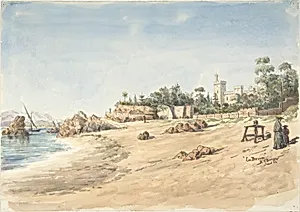
Medium
Watercolor
Dimensions
Sheet: 9 1/2 x 12 3/4 in. (24.1 x 32.4cm)
Classification
Drawings
Department
Drawings and Prints
Museum
Metropolitan Museum of Art, New York, NY
Credit
Bequest of H.V. Burgy, 1901
Accession Number
01.23.175
Rights
Public Domain
Tags
Art Historical Context
**La Bocca**, a delicate watercolor landscape by Henry Victorgy from 1882, captures artist's keen eye for natural beauty on a modest sheet measuring 9½ x 12¾ inches. Housed in the Metropolitan Museum of Art's Department of Drawings and Prints, work exemplifies the intimate scale of 19th-century, inviting viewers to lean in and savor its subtle details. Created during a period when European artists increasingly turned to plein-air sketching to document scenic vistas, Burgy's piece reflects the era's fascination with light, atmosphere, and the unspoiled countryside. Watercolor, Burgy's chosen medium, lends itself perfectly to landscapes through its luminous transparency and fluid application, allowing for evocative washes that suggest depth and movement without heavy outlines. As a classified drawing, it highlights the technical virtuosity of the watercolor technique—layering pigments on paper to evoke transient effects like mist or sunlight filtering through foliage. Though specifics of the scene remain evocative rather than literal, the title *La Bocca* ("The Mouth" in Italian) hints at a coastal or riverine motif, common in landscape traditions. This gem entered the Met's collection through the artist's own bequest in 1901, a poignant legacy that underscores Burgy's commitment to sharing his vision. For visitors, *La Bocca* offers a window into late 19th-century artistic practice, reminding us how a small watercolor can evoke vast horizons.
About the Artist
Henry Victor Burgy · 1801–1901
Henry Victor Burgy (1801–1901) was a French painter whose serene landscapes capture the luminous beauty of southern France and historic châteaux in the late nineteenth century. Little is known about his early life or formal training, as biographical details remain scarce in art historical records. Active primarily in his later decades, Burgy produced works that reflect a personal affinity for coas...