
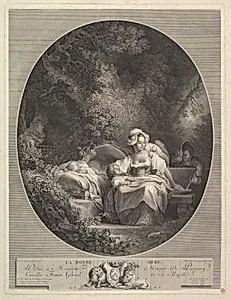
La Bonne Mere
Medium
Etching, third state
Dimensions
sheet: 26 11/16 x 21 1/8 in. (67.8 x 53.6 cm) image: 22 1/8 x 16 3/4 in. (56.2 x 42.5 cm)
Classification
Prints
Department
Drawings and Prints
Museum
Metropolitan Museum of Art, New York, NY
Credit
Purchase, Roland L. Redmond Gift, Louis V. Bell and Rogers Funds, 1972
Accession Number
1972.539.29
Rights
Public Domain
Tags
Art Historical Context
**La Bonne Mère (The Good Mother)** enchanting etching, titled *La Bonne Mère* (The Good Mother), is a collaboration the celebrated Rococo painter Jean Honoré Fragonard master engraver Nicolas de Launay. Created in the third state—a refined stage of printmaking where details were polished for greater clarity and depth—it captures Fragonard's signature playful elegance in a reproductive print. Likely based on one of Fragonard's whimsical compositions, the image evokes 18th-century French aristocracy through motifs like infants, nurturing women, majestic lions symbolizing strength and nobility, lush trees, and an ornate coat of arms. Measuring an impressive 26 11/16 x 21 1/8 inches overall, it exemplifies the technical virtuosity of etching, where acid bites into a metal plate to produce intricate lines that mimic painting's fluidity. Fragonard's Rococo style, with its lighthearted sensuality and decorative charm, flourished in the opulent courts of Louis XV's France, making prints like this accessible luxury items for collectors. Launay's skilled translation preserved the artist's delicate brushwork, highlighting etching's role in disseminating elite art to a wider audience. Housed in the Metropolitan Museum of Art's Drawings and Prints department (acquired in 1972), *La Bonne Mère* offers a window into the era's fascination with idealized motherhood and heraldry, blending tenderness with grandeur in a timeless tableau.
About the Artist
Jean Honoré Fragonard|Nicolas de Launay · 1732–1806
Jean-Honoré Fragonard (1732-1806) was a French painter and printmaker whose late Rococo manner was distinguished by remarkable facility, exuberance, and hedonism. Born in Grasse, he moved to Paris where he trained under Jean-Baptiste Chardin and François Boucher, winning the prestigious Prix de Rome in 1752. After studying in Italy alongside Hubert Robert, Fragonard returned to Paris in 1761 to fi...