
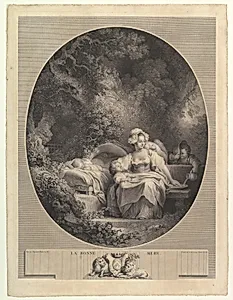
La Bonne Mere
Medium
Etching, between second and third states
Dimensions
sheet: 24 15/16 x 18 3/4 in. (63.3 x 47.7 cm) image: 22 7/16 x 16 13/16 in. (57 x 42.7 cm)
Classification
Prints
Department
Drawings and Prints
Museum
Metropolitan Museum of Art, New York, NY
Credit
Purchase, Roland L. Redmond Gift, Louis V. Bell and Rogers Funds, 1972
Accession Number
1972.539.28
Rights
Public Domain
Tags
Art Historical Context
**La Bonne Mère** is a captivating etching after Jean-Honoré Frard, masterfully executed by engraver Nicolas de Launay Created in the late 18th century during the height of the Rococo period, this print (dated n.d., between and third states) capturesagonard's signature playful elegance. Measuring nearly 25 by 19 inches on the sheet, belongs to the Metropolitan Museum of Art's Drawings and Prints collection, acquired in 1972 through generous gifts and funds. The composition tenderly portrays a devoted mother cradling her infant, surrounded by lush trees and a prominent coat of arms—evoking themes of maternal love, nature's bounty, and perhaps noble patronage. Fragonard's Rococo style shines through in its soft, fluid lines and intimate emotion, while Launay's etching technique allowed for intricate details and tonal subtlety, making high art accessible via prints. This state of the etching offers a rare glimpse into the printmaking process, bridging painting and reproduction. As an affordable medium, it democratized Fragonard's whimsical world, celebrating everyday joys amid France's opulent ancien régime. A delightful window into 18th-century sentimentality! (198 words)
About the Artist
Jean Honoré Fragonard|Nicolas de Launay · 1732–1806
Jean-Honoré Fragonard (1732-1806) was a French painter and printmaker whose late Rococo manner was distinguished by remarkable facility, exuberance, and hedonism. Born in Grasse, he moved to Paris where he trained under Jean-Baptiste Chardin and François Boucher, winning the prestigious Prix de Rome in 1752. After studying in Italy alongside Hubert Robert, Fragonard returned to Paris in 1761 to fi...