
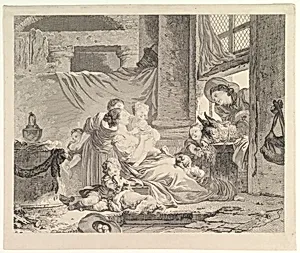
La Famille du Fermier
Medium
Etching, before first state
Dimensions
sheet: 15 15/16 x 19 in. (40.5 x 48.2 cm) image: 14 3/16 x 17 5/8 in. (36 x 44.8 cm)
Classification
Prints
Department
Drawings and Prints
Museum
Metropolitan Museum of Art, New York, NY
Credit
Purchase, Roland L. Redmond Gift, Louis V. Bell and Rogers Funds, 1972
Accession Number
1972.539.25
Rights
Public Domain
Tags
Art Historical Context
**La Famille du Fermier is a charming etching that captures the warmth of rural family life, designed by the celebrated Rococo master Jean Honoré Fragonard and by engravers Antoine Louis Romanet and Clément Marillier. Dated undated but likely from the late 18th century, this print a farmer's family—men, women, boys, and even a loyal dog—in a lively domestic scene. Measuring nearly 16 by 19 inches on the sheet, it's an exceptionally rare "before first state proof, meaning it preserves the etching's initial lines before further refinement, offering a glimpse into the printmaking process. Fragonard, a leading figure in French Rococo art, was renowned for his playful, elegant depictions of everyday joys, often idealizing pastoral settings amid the opulence of pre-Revolutionary France. Romanet and Marillier, skilled collaborators, translated his fluid designs into intricate etched lines, a technique that allowed for delicate shading and expressive detail on copper plates. This medium was popular for disseminating art to a wider audience, bridging elite tastes with bourgeois homes. Housed in the Metropolitan Museum of Art's Drawings and Prints department, acquired in 1972, *La Famille du Fermier* exemplifies the era's fascination with sentimental genre scenes. It invites visitors to appreciate not just the tender family bonds but also the artistry of print proofs, rare survivors that reveal the collaborative magic behind Fragonard's enduring whimsy.
About the Artist
Jean Honoré Fragonard|Antoine Louis Romanet|Clément Pierre Marillier · 1732–1806
Jean-Honoré Fragonard (1732-1806) was a French painter and printmaker whose late Rococo manner was distinguished by remarkable facility, exuberance, and hedonism. Born in Grasse, he moved to Paris where he trained under Jean-Baptiste Chardin and François Boucher, winning the prestigious Prix de Rome in 1752. After studying in Italy alongside Hubert Robert, Fragonard returned to Paris in 1761 to fi...