
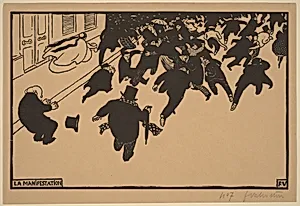
La Manifestation (The Demonstration)
1893
Medium
woodcut
Classification
Department
CG-E
Museum
National Gallery of Art, Washington, D.C.
Credit
Rosenwald Collection
Accession Number
1952.8.476
Rights
Public Domain
Art Historical Context
Félix Vallotton’s 1893 woodcut *La Manifestation* captures the restless energy of a street demonstration in fin-de-siècle Paris. Created during a period of social and political ferment in France, the print reflects the era’s growing public protests and labor movements. Vallotton, a Swiss-born artist who settled in Paris and joined the Nabis group, used the woodcut medium to distill modern urban life into striking, simplified forms. The work exemplifies Vallotton’s innovative approach to the woodcut, a technique he helped revive in the 1890s. By exploiting the medium’s bold contrasts of black and white, he created dynamic compositions that evoke both the collective force of the crowd and the individual figures within it. His crisp, graphic style—shaped in part by Japanese prints—gives the scene a modern, almost cinematic quality that feels remarkably fresh more than a century later. Housed in the National Gallery of Art’s Rosenwald Collection, *La Manifestation* remains a compelling record of how printmaking could address contemporary social themes with both clarity and emotional power.
About the Artist
Félix Vallotton · 1865–1925
Félix Vallotton (1865–1925) was born in Lausanne, Switzerland, into a comfortable middle-class family, and moved to Paris in 1882 to enroll at the Académie Julian, where he studied under the portrait painter Jules Joseph Lefebvre and the history painter Gustave Boulanger. Paris would remain his home for the rest of his life, and he became a French citizen in 1900 following his marriage to the art ...