
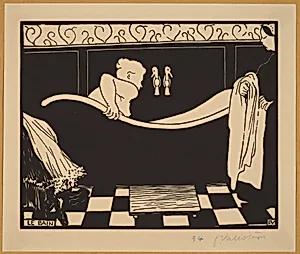
Le Bain (The Bath)
1894
Medium
woodcut
Classification
Department
CG-E
Museum
National Gallery of Art, Washington, D.C.
Credit
Rosenwald Collection
Accession Number
1952.8.474
Rights
Public Domain
Art Historical Context
Félix Vallotton’s *Le Bain (The Bath)* of 1894 exemplifies the artist’s pivotal role in reviving the woodcut as a modern artistic medium during the late nineteenth century. Working in Paris, Vallotton simplified forms into stark black-and-white contrasts, drawing inspiration from Japanese ukiyo-e prints while exploring intimate domestic subjects. The woodcut technique allowed him to achieve bold, graphic effects that emphasize pattern and silhouette over delicate modeling. Created at the height of the Nabis circle’s influence, this print reflects the era’s fascination with everyday scenes rendered with quiet detachment. Vallotton often depicted the female figure in private moments, using the medium’s inherent flatness to create a sense of both closeness and distance. His precise carving and inventive use of negative space helped elevate printmaking from reproduction to fine art. Today, works like *Le Bain* in the National Gallery of Art’s Rosenwald Collection highlight Vallotton’s lasting contribution to graphic art, bridging Symbolist sensibilities with the emerging aesthetics of the twentieth century.
About the Artist
Félix Vallotton · 1865–1925
Félix Vallotton (1865–1925) was born in Lausanne, Switzerland, into a comfortable middle-class family, and moved to Paris in 1882 to enroll at the Académie Julian, where he studied under the portrait painter Jules Joseph Lefebvre and the history painter Gustave Boulanger. Paris would remain his home for the rest of his life, and he became a French citizen in 1900 following his marriage to the art ...