
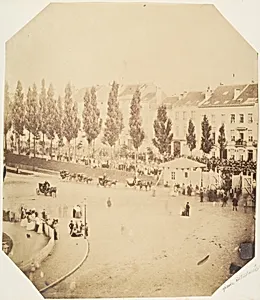
La place pendant les fêtes de septembre
Medium
Salted paper print from paper negative
Dimensions
Image: 10 5/8 × 9 3/16 in. (27 × 23.3 cm) Sheet: 13 3/8 × 18 1/8 in. (34 × 46 cm)
Classification
Photographs
Department
Photographs
Museum
Metropolitan Museum of Art, New York, NY
Credit
Gilman Collection, Gift of The Howard Gilman Foundation, 2005
Accession Number
2005.100.372.20
Rights
Public Domain
Tags
Art Historical Context
Step into the bustling heart of mid-19th-century France *La place pendant les fêtes septembre* (The Square During the September Festivals a salted paper print from a paper negative by Louis-Pierre-Théophile Dubois de Neaut, created between 1854 and 1856. This intimate 10 5/8 × 9 3/16-inch image captures a lively urban square alive with celebration, featuring grand buildings, winding streets, and horse-drawn carriages amid festive crowds. Housed in the Metropolitan Museum of Art's Gilman Collection, it a rare window into everyday Parisian revelry during September's joyous fêtes—likely harvest or civic holidays that filled city plazas with merriment. Dubois de Nehaut, a lesser-known pioneer in early photography, employed the calotype process, pioneered by William Henry Fox Talbot in the 1840s. This technique used paper negatives coated in silver iodide and salted with sodium chloride, producing soft, textured prints with subtle tonal gradients that evoke the era's atmospheric haze. Unlike sharper daguerreotypes, salted paper prints like this one prioritized artistic mood over precision, blending documentary realism with painterly poetry. Its cultural significance lies in documenting transient urban life just as photography emerged as a democratic medium, freezing fleeting moments of communal joy. A testament to 1850s innovation, it reminds us how cameras began reshaping our view of history's vibrant streets. (198 words)
About the Artist
Louis-Pierre-Théophile Dubois de Nehaut · 1799–1872
Louis-Pierre-Théophile Dubois de Nehaut (1799–1872) was a French artist and early enthusiast of photography whose career bridged the worlds of traditional draughtsmanship and the new mechanical image-making technologies that transformed visual culture in the nineteenth century. Trained in the conventions of French academic art, he possessed the skills of a practiced draughtsman before turning his ...