
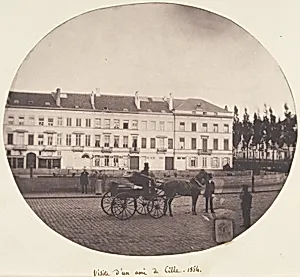
Visite d'un ami de Lille
Medium
Salted paper print from paper negative
Dimensions
Image: 6 1/16 × 7 1/16 in. (15.4 × 17.9 cm) Sheet: 13 3/8 × 18 1/8 in. (34 × 46 cm)
Classification
Photographs
Department
Photographs
Museum
Metropolitan Museum of Art, New York, NY
Credit
Gilman Collection, Gift of The Howard Gilman Foundation, 2005
Accession Number
2005.100.372.21
Rights
Public Domain
Tags
Art Historical Context
**Visite d'un ami Lille** (Visit of a Friend from Lille created in 1854 by French Louis-Pierre-Théophile de Nehaut, a charming moment of 19th-century social life This salted paper print from a paper depicts men, horses, and carriages grand buildings, evoking the arrival of a visitor from Lille, a bustling northern French city. At just 6 1/16 × 7 1/16 inches, the intimate image draws viewers into a poised, everyday scene blending urban architecture with equestrian elegance. Printed using the calotype process pioneered by William Henry Fox Talbot, this work exemplifies early photography's revolutionary paper negative technique. Unlike sharp daguerreotypes, salted paper prints offered subtle tonal gradations and the ability to produce multiple positives from one negative—a breakthrough that democratized image-making. In 1854, just 15 years after photography's public debut, Dubois de Nehaut harnessed this method to document transient social rituals, bridging painting's narrative tradition with the camera's precision. Housed in the Metropolitan Museum of Art's Gilman Collection, this photograph highlights photography's swift evolution from novelty to artistic medium. It invites us to ponder the era's blend of tradition and innovation, where a simple visit becomes a timeless snapshot of connection amid horse-drawn progress.
About the Artist
Louis-Pierre-Théophile Dubois de Nehaut · 1799–1872
Louis-Pierre-Théophile Dubois de Nehaut (1799–1872) was a French artist and early enthusiast of photography whose career bridged the worlds of traditional draughtsmanship and the new mechanical image-making technologies that transformed visual culture in the nineteenth century. Trained in the conventions of French academic art, he possessed the skills of a practiced draughtsman before turning his ...