
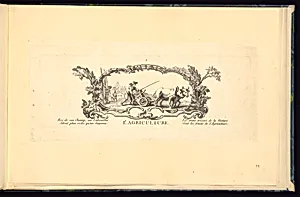
L’AGRICULTURE
mid- 18th–late 18th century
Classification
Department
Smithsonian Collection
Museum
Smithsonian American Art Museum
Credit
Purchased for the Museum by the Advisory Council
Accession Number
1921-6-349-29
Rights
Public Domain
About this artwork
Research in Progress
Art Historical Context
**L’AGRICULTURE** by Jacques Bacheley (French, 1712–1781) is a captivating 18th-century print that celebrates the vital theme of agriculture, a cornerstone of Enlightenment-era thought in France. Created during the mid- to late 1700s, this work reflects the period's growing fascination with rural life and economic productivity, influenced by physiocratic ideas that positioned farming as the foundation of national wealth. Bacheley, a skilled French printmaker, likely employed techniques such as engraving or etching—hallmarks of the Rococo and early Neoclassical styles—to produce intricate, reproducible images that could disseminate ideals of harmony between humanity and the land. As a print, the artwork's medium was revolutionary for its time, allowing widespread distribution to educate and inspire audiences beyond elite circles. Though details of its exact composition remain under research, the title evokes allegorical depictions common in French art, possibly featuring idealized peasants, bountiful harvests, or symbolic figures embodying fertility and labor. Its presence in the Smithsonian American Art Museum's collection, acquired through the Advisory Council's purchase, underscores transatlantic cultural exchanges, bridging European artistic traditions with American interests in agrarian heritage. This piece invites visitors to ponder agriculture's timeless role in society, offering a window into 18th-century values amid ongoing scholarly exploration. (198 words)