
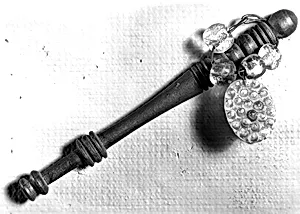
Lace Bobbin
19th century
Medium
Turned wood with rose and crystal bead ornament
Dimensions
8.6 × 7 cm (3 3/8 × 11 in.)
Classification
bobbins
Department
Textiles
Museum
Art Institute of Chicago
Accession Number
50409
Rights
Public Domain
Art Historical Context
This delicate 19th-century lacebin, crafted from turned wood and adorned with rose and crystal, exemplifies the exquisite craftsmanship of everyday tools in Victorian-era textile arts. Measuring just 8.6 × 7 cm, its petite scale belies its pivotal role in bobbin lacemaking—a technique where weighted bobbins hold threads twisted into intricate patterns on a pillow. Housed in the Art Institute of Chicago's Department, this unsigned piece highlights how functional objects could become works of art through skilled lathe-turning, which shapes the wood into smooth, ergonomic forms ideal for hours of precise work. Lacemaking flourished in the 19th century as a cottage industry across Europe, particularly in regions like England, France, and Belgium, where it supplied the demand for fine lace in fashion, linens, and ecclesiastical vestments. Women often created these bobbins as personal treasures, embellishing them with beads for beauty and balance—crystal for subtle shimmer, rose motifs evoking femininity and floral elegance. Though humble, such tools underscore the artistry in "women's work," blending utility with ornamentation. Today, this bobbin invites us to appreciate the unseen labor behind ornamental textiles, reminding visitors of the cultural prestige lace once held in domestic life. A testament to anonymous makers' ingenuity!
About the Artist
Unknown
The artist designated as "Unknown" in our virtual museum's collection exemplifies a poignant chapter in art history: creators whose identities have faded into obscurity despite the enduring power of their work. With only one known artwork attributed to them in our holdings, this figure represents countless anonymous hands that shaped visual culture across centuries. Museums worldwide, including th...