
Landscape
17th century
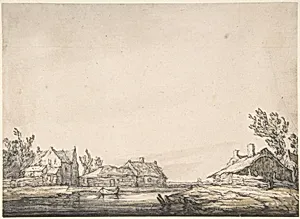
Medium
Black chalk, gray and green wash
Dimensions
5 5/16 x 7 5/16 in. (13.5 x 18.6 cm)
Classification
Drawings
Department
Drawings and Prints
Museum
Metropolitan Museum of Art, New York, NY
Credit
H. O. Havemeyer Collection, Bequest of Mrs. H. O. Havemeyer, 1929
Accession Number
29.100.931
Rights
Public Domain
Tags
Art Historical Context
Step into the serene world of 17th-century Dutch countryside with Aelbert Cuyp's delicate *Landscape*, a gem from the Metropolitan Museum of's Drawings and Prints department. Created during the Dutch Golden Age—a period of economic prosperity and artistic innovation—Cuyp (1620–1691), a master from Dordrecht, captures the flat pastoral expanses that defined his homeland. This intimate drawing, measuring just 5 5/16 x 7 5/16 inches, likely served as a preparatory study, blending everyday houses nestled amid rolling landscapes. Rendered in black chalk heightened with subtle gray and green washes, work showcases Cuyp's skillful use of mixed media to evoke atmospheric depth and luminosity. Washes add a soft, tonal glow, mimicking the golden light for which Cuyp's oil paintings are renowned, influenced by Italianate realism yet rooted in Dutch naturalism. These techniques highlight the era's fascination with *sketches* as autonomous artworks, valued for their spontaneity and direct observation of nature. Bequeathed through the H.O. Havemeyer Collection in 1929, this piece reflects Cuyp's enduring legacy in celebrating humble rural scenes, offering visitors a window into the harmonious blend of human habitation and nature that symbolized 17th-century Dutch identity.
About the Artist
Aelbert Cuyp · 1620–1691
Aelbert Cuyp (1620–1691), a leading figure of the Dutch Golden Age, was born and died in Dordrecht, Netherlands, where he spent his entire life. The son of portraitist and animal painter Jacob Gerritsz Cuyp (1594–1652), Aelbert came from a family of artists—his uncle Benjamin Gerritsz Cuyp and grandfather Gerrit Gerritsz Cuyp were stained-glass designers—and studied under his father, with whom he ...