
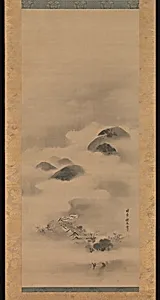
狩野探幽筆 月夜山水図|Landscape in Moonlight
after 1662
Medium
One of a triptych of hanging scrolls; ink on silk
Dimensions
Image: 39 5/8 x 16 3/4 in. (100.6 x 42.5 cm) Overall: 75 1/4 x 23 1/2 in. (191.1 x 59.7 cm)
Classification
Paintings
Culture & Period
Japan · Edo period (1615–1868)
Department
Asian Art
Museum
Metropolitan Museum of Art, New York, NY
Credit
The Harry G. C. Packard Collection of Asian Art, Gift of Harry G. C. Packard, and Purchase, Fletcher, Rogers, Harris Brisbane Dick, and Louis V. Bell Funds, Joseph Pulitzer Bequest, and The Annenberg Fund Inc. Gift, 1975
Accession Number
1975.268.51
Rights
Public Domain
Tags
Art Historical Context
**Landscape in Moonlight** Kano Tan'yū captures the ethereal beauty of a nocturnal scene, painted after 1662 during Japan's Edo period (16151868). As one panel of a majestic triptych of hanging scrolls, this ink-on-silk work measures nearly 40 inches tall, designed to unfurl dramatically in a tokonoma alcove, inviting viewers into a world of misty mountains and tranquil waters bathed in soft moonlight. Tan'yū, a master of the Kano school—the preeminent painting lineage serving the shogunate—blended bold brushwork with subtle gradations, evoking the school's signature professional style that fused Chinese literati traditions with Japanese elegance. Hanging scrolls like this were prized possessions in Edo-era homes and castles, symbolizing refined taste and harmony with nature. Ink on silk allowed Tan'yū's fluid lines and layered washes to shimmer, creating depth and atmosphere that draw the eye through receding space—a technique honed over generations in the Kano atelier. This piece, from the Metropolitan Museum of Art's Harry G. C. Packard Collection, exemplifies how Edo artists elevated landscape painting to celebrate impermanence and poetic serenity, resonating with Zen ideals of quiet contemplation under the moon.
About the Artist
Kano Tan'yū (Japanese) · 1602 –1674
Japanese, 1602–1674