
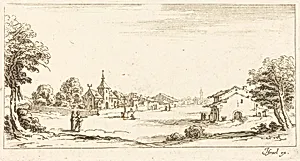
Landscape
in or after 1635
Medium
etching on laid paper
Dimensions
plate: 9 × 7 cm (3 9/16 × 2 3/4 in.) sheet (irreg.): 12.2 × 21 cm (4 13/16 × 8 1/4 in.)
Classification
Department
CG-E
Museum
National Gallery of Art, Washington, D.C.
Credit
R.L. Baumfeld Collection
Accession Number
1969.15.145
Rights
Public Domain
Art Historical Context
This etching titled *Landscape*, created after Jacques Callot in or after 1635, showcases the enduring appeal of one of the 17th century’s most influential printmakers. Callot, a French artist active during the Baroque period, helped elevate etching from a reproductive craft into a sophisticated artistic medium through his mastery of fine detail and expressive line work. Produced on laid paper, the small plate (just 9 × 7 cm) demonstrates how etching allowed artists to capture delicate textures and atmospheric depth in a format that could be widely shared. Although made after Callot’s death in 1635, the work reflects his characteristic approach to landscape, where natural forms are rendered with precision and a sense of lively movement. Etching’s ability to produce multiple impressions made such scenes accessible beyond elite collectors, spreading Callot’s vision across Europe and influencing later generations of printmakers. Now part of the National Gallery of Art’s R.L. Baumfeld Collection, this intimate print offers today’s visitors a window into the technical and cultural significance of 17th-century graphic art. Its modest size encourages close looking, rewarding viewers with the subtle tonal variations possible on handmade laid paper.
About the Artist
after Jacques Callot
**Jacques Callot (c. 1592–1635)**, the master whose designs inspired the works attributed "after Jacques Callot," was a pioneering French Baroque printmaker and draftsman born in Nancy, capital of the independent Duchy of Lorraine (now northeastern France). From a noble family—his father served as master of ceremonies and herald-at-arms to the Duke of Lorraine—young Callot was apprenticed to a gol...