
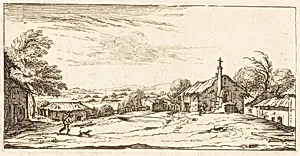
Landscape
in or after 1635
Medium
etching on laid paper
Dimensions
plate: 8 × 6.1 cm (3 1/8 × 2 3/8 in.) sheet (irreg.): 10.4 × 19.9 cm (4 1/8 × 7 13/16 in.)
Classification
Department
CG-E
Museum
National Gallery of Art, Washington, D.C.
Credit
R.L. Baumfeld Collection
Accession Number
1969.15.151
Rights
Public Domain
Art Historical Context
This delicate etching, titled *Landscape and created in or after 1635, homage to the masterful style of Jacques Callot, a pioneering French printmaker of the Baroque era. Callot (1592–1635) revolutionized etching with his intricate, small-scale compositions, capturing landscapes, battles, and everyday scenes with astonishing detail. Produced "after" Callot—likely by a follower or studio artist—this work reflects his influence during a time of artistic innovation in 17th-century Europe, amid the Thirty Years' War, when prints became vital for disseminating images widely. Etched on laid paper, the modest plate measures just 8 × 6.1 cm, inviting close inspection of its fine lines and textures—a hallmark of the intaglio technique, where acid etches designs into a metal plate for multiple impressions. Callot's landscapes often evoked the rugged beauty of his native Lorraine, blending realism with dramatic light and shadow, making portable art accessible beyond elite patrons. Housed in the National Gallery of Art's CG-E department from the R.L. Baumfeld Collection, this print exemplifies the enduring appeal of Callot's legacy. Visitors will appreciate its intimacy, a window into Baroque mastery that transformed printmaking into a democratic medium.
About the Artist
after Jacques Callot
**Jacques Callot (c. 1592–1635)**, the master whose designs inspired the works attributed "after Jacques Callot," was a pioneering French Baroque printmaker and draftsman born in Nancy, capital of the independent Duchy of Lorraine (now northeastern France). From a noble family—his father served as master of ceremonies and herald-at-arms to the Duke of Lorraine—young Callot was apprenticed to a gol...