
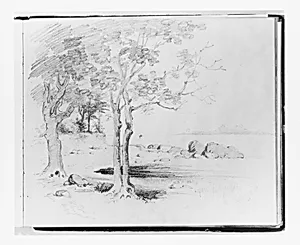
Landscape with Foreground Trees (from Sketchbook)
ca. 1838 and after
Medium
Graphite on off-white wove paper
Dimensions
6 5/8 x 8 in. (16.8 x 20.3 cm)
Classification
Drawing
Culture
American
Department
The American Wing
Museum
Metropolitan Museum of Art, New York, NY
Credit
Sheila and Richard J. Schwartz Fund, 1987
Accession Number
1987.196.3ee
Rights
Public Domain
Tags
Art Historical Context
Step into the serene world of 19th America through *Landscape with Foreground Trees*, delicate sketch from the notebook of Francis William Edmonds, dated 1838 and later. This intimate graphite drawing on off-white wove paper just 6⅝ × 8 inches, capturing a modest yet evocative vista where sturdy foreground trees frame a distant landscape. Edmonds, a New York banker-turned-artist (1806–1863), was renowned for his precise, detailed renderings inspired by everyday scenes and nature, bridging the gap between European traditions and emerging American realism. Created during a period when American artists were increasingly turning to their own landscapes amid national expansion, this sketchbook page highlights the preparatory nature of such works. Graphite on wove paper—a smooth, affordable medium popularized in the early 1800s—allowed for subtle shading and fine lines, making it ideal for outdoor studies. Edmonds' meticulous technique reflects the era's growing appreciation for nature as a source of national identity, predating the grand Hudson River School visions. Now housed in the Metropolitan Museum of Art's American Wing, thanks to the Sheila and Richard J. Schwartz Fund (1987), this unpretentious gem invites us to appreciate the quiet artistry behind finished paintings, reminding visitors of the thoughtful process that brought America's budding artistic heritage to life.
About the Artist
Francis William Edmonds · 1806–1863
Francis William Edmonds, born on November 22, 1806, in Hudson, New York, into a prominent Quaker family as the seventh child of storekeeper and public servant Samuel Edmonds and Lydia Worth Edmonds, displayed remarkable artistic talent from youth. After Quaker schooling and farm work, he entered banking in 1823 as a clerk at the Tradesmen's Bank in New York City under his uncle Gorham Worth, a pat...