
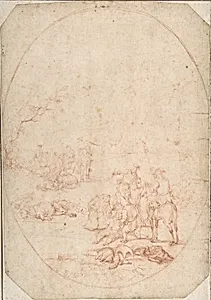
Landscape with Soldiers Helping the Wounded after a Battle
17th century
Medium
Red chalk (laid down on larger sheet with frame in pen and ink)
Dimensions
11 x 8 1/4 in. Oval
Classification
Drawings
Department
Drawings and Prints
Museum
Metropolitan Museum of Art, New York, NY
Credit
Gift of Harry G. Friedman, 1957
Accession Number
57.658.273
Rights
Public Domain
Tags
Art Historical Context
Nestled in the Metropolitan Museum Art's Drawings and Prints collection, *Landscape with Soldiers Helping theounded after a Battle* a poignant 17th-century red chalk drawing by an anonymous artist of the 18th century This intimate oval composition, measuring just 11 x 8¼ inches and laid down on a larger with a pen-and-ink frame, captures the somber aftermath of conflict. Soldiers tenderly aid the wounded amid a rugged landscape dotted with horses, evoking human cost of war through tags like "Soldiers," "Suffering," and "Landscapes." Red chalk, favored in French draftsmanship for its warm, fleshy tones and subtle blending, lends emotional depth here, allowing the artist to convey exhaustion and compassion with delicate strokes. The oval format, uncommon for battle scenes, draws viewers into a meditative vignette, perhaps reflecting the era's shifting views on warfare during Louis XIV's reign, when grand military campaigns contrasted with intimate depictions of their toll. Gifted to the Met in 1957 by Harry G. Friedman, this anonymous gem highlights the artistry of preparatory sketches, blending topography with tragedy. It invites reflection on resilience and mercy, reminding us that even in chaos, humanity endures.
About the Artist
Anonymous, French, 18th century · 1700–1800
The artist known as Anonymous, French, 18th century, represents a collective of unidentified talents active roughly between 1700 and 1800, a period of profound artistic evolution in France from the opulent Rococo to the austere dawn of Neoclassicism and Revolutionary fervor. Little is documented about their personal training or mentors, as their anonymity obscures individual biographies, though th...