
Landscape with Trees
1895/1898
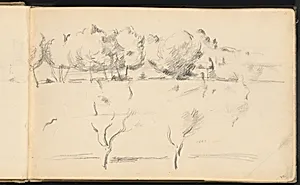
Medium
graphite on wove paper
Dimensions
overall: 15.2 x 23.7 cm (6 x 9 5/16 in.)
Classification
Drawing
Department
CG-E
Museum
National Gallery of Art, Washington, D.C.
Credit
Collection of Mr. and Mrs. Paul Mellon, in Honor of the 50th Anniversary of the National Gallery of Art
Accession Number
1992.51.9.f
Rights
Public Domain
Art Historical Context
Paul Cézanne's * with Trees*, created between 1895 and1898, captures the artist's profound fascination with the Provençal countryside near his hometown of Aix-en-Provence. As a cornerstone of Post-Impressionism, Canne moved beyond the fleeting light effects of Impressionism to explore the underlying structure of nature. This intimate drawing, rendered in graphite on smooth wove paper, exemplifies his methodical approach, using precise lines and subtle shading to build volume and depth in trees and terrain. At just 15.2 x 23.7 cm, it feels like a personal sketch from his outdoor studies, inviting viewers to trace his constructive geometry. The medium of graphite on wove paper was ideal for Cézanne's technique, allowing fine control over tonal gradations and overlapping forms—hallmarks of his revolutionary vision that influenced modern masters like Picasso and Braque. Dating to his mature period, this work reflects Cézanne's quest to "treat nature by means of the cylinder, the sphere, the cone," transforming a simple landscape into a foundational exercise in form and space. Generously donated by Mr. and Mrs. Paul Mellon to honor the National Gallery of Art's 50th anniversary, *Landscape with Trees* resides in the museum's esteemed collection. It offers visitors a window into Cézanne's genius, reminding us how a modest drawing can redefine how we see the world.
About the Artist
Paul Cezanne · 1839–1906
Paul Cézanne (1839–1906), born in Aix-en-Provence to a prosperous banker father, Louis-Auguste, and mother Anne-Elisabeth-Honorine Aubert, grew up in a bourgeois family that later acquired the Jas de Bouffan estate, where he painted his earliest murals. As a youth, he formed the inseparable trio "Les Trois Inséparables" with schoolmates Émile Zola and Baptistin Baille. Despite his father's wishes ...