
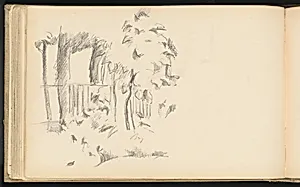
Near the Pool at Jas de Bouffan
1883/1887
Medium
graphite on wove paper
Dimensions
overall: 15.2 x 23.7 cm (6 x 9 5/16 in.)
Classification
Drawing
Department
CG-E
Museum
National Gallery of Art, Washington, D.C.
Credit
Collection of Mr. and Mrs. Paul Mellon, in Honor of the 50th Anniversary of the National Gallery of Art
Accession Number
1992.51.9.eee
Rights
Public Domain
Art Historical Context
**Near the Pool at Jas de Bouffan** is a delicate graphite drawing by Paul Cézanne, created between 1883 and 1887. This intimate study captures a serene corner of the artist's family estate, Jas de Bouffan, near Aix-en-Provence southern France. Cézanne a pivotal Post-Impressionist, obsessively returned to this landscape throughout his career, using it as a personal laboratory to explore form, light, and space. The estate's lush gardens and reflective pool inspired dozens of his oil paintings, making this drawing a window into his iterative creative process during a transitional period in his work. Executed on smooth wove paper—a favored 19th-century support for precise graphite work—the piece measures just 15.2 x 23.7 cm, inviting close contemplation. Cézanne's technique reveals his revolutionary approach: subtle hatching and contour lines build volume and depth, eschewing Impressionist spontaneity for structured observation. These preparatory sketches were foundational to his mature style, influencing modern masters like Picasso by emphasizing the geometry of nature over fleeting effects. Generously gifted to the National Gallery of Art by Mr. and Mrs. Paul Mellon in honor of the museum's 50th anniversary, this drawing exemplifies Cézanne's enduring legacy. It reminds us how everyday scenes, rendered with patient precision, reshaped Western art, bridging tradition and abstraction.
About the Artist
Paul Cezanne · 1839–1906
Paul Cézanne (1839–1906), born in Aix-en-Provence to a prosperous banker father, Louis-Auguste, and mother Anne-Elisabeth-Honorine Aubert, grew up in a bourgeois family that later acquired the Jas de Bouffan estate, where he painted his earliest murals. As a youth, he formed the inseparable trio "Les Trois Inséparables" with schoolmates Émile Zola and Baptistin Baille. Despite his father's wishes ...