
Landslide (Bergsturz)
1881
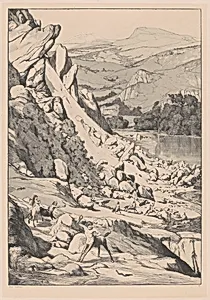
Medium
etching and aquatint
Classification
Department
CG-E
Museum
National Gallery of Art, Washington, D.C.
Credit
Corcoran Collection (Bequest of Frank B. Bristow)
Accession Number
2015.19.1549
Rights
Public Domain
Art Historical Context
Max Klinger's *Landslide (Bergst)*, created in 1881, is a striking example of the German artist's mastery in printmaking. As a key figure in late 19th-century Symbolism Klinger blended meticulous realism with fantastical visions, often drawing from nature's raw power to evoke deeper emotional and psychological truths. This work, housed in the National of Art's Corcor Collection (gift of Frank B. Brow), captures the dramatic chaos of a mountainside collapse, rendered with Klinger's signature precision. The medium—etching combined with aquatint—lends the piece its haunting depth. Etching allows for intricate, controlled lines to define rocks and debris, while aquatint introduces velvety tonal gradients, mimicking the dust clouds and shadows of a real catastrophe. This technique, popular among Symbolists, enabled artists like Klinger to rival painting's richness on paper, making complex imagery accessible through affordable prints. In the context of 1880s Europe, amid rapid industrialization and Romantic echoes of nature's sublime force, *Landslide* reflects humanity's precarious place in the world. A testament to Klinger's innovative cycles of etchings, it invites visitors to ponder destruction's beauty, bridging fine art traditions with modern graphic expression.
About the Artist
Max Klinger · 1857–1920
Max Klinger, born on February 18, 1857, in Leipzig to a wealthy family, emerged as one of Germany's most innovative artists across painting, sculpture, printmaking, and graphics. Demonstrating early talent, he enrolled at the Academy of Fine Arts in Karlsruhe in 1874 as a pupil of Karl Gussow, following his teacher to the Berlin Academy upon Gussow's appointment as director, and graduated in 1877 ...