
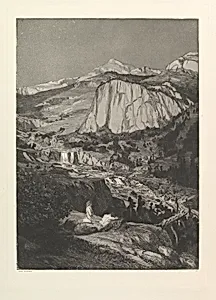
Mondnacht, from Intermezzi, plate 4
n.d.
Medium
Etching and aquatint
Dimensions
plate: 16 9/16 x 11 13/16 in. (42 x 30 cm) sheet: 20 11/16 x 16 9/16 in. (52.5 x 42 cm)
Classification
Prints
Department
Drawings and Prints
Museum
Metropolitan Museum of Art, New York, NY
Credit
Gift of the Estate of Mrs. Edward Robinson. 1952
Accession Number
52.594.27
Rights
Public Domain
Tags
Art Historical Context
Max Klinger's *Mondnacht* (Moonlit Night), 4 from the *Intermezzi* series captures a dreamlike nocturnal landscape blending ethereal mountains, vast skies, and enigmatic human figures. Created by the German Symbolist artist (1857–1920), this print reflects Klinger's fascination with fantasy and the subconscious, bridging Realism and the emerging Jugendstil movement. As part of his innovative graphic cycles from the late 19th century, *Intermezzi* explores poetic intermissions between reality and reverie, inviting viewers into otherworldly scenes. The work's etching and aquatint technique masterfully renders subtle tonal gradations, from velvety shadows to luminous moonlight, evoking a sense of mystery and depth. Etching provides precise lines for contours, while aquatint adds soft, painterly textures ideal for atmospheric night effects— a technical innovation Klinger pioneered in printmaking. Housed in the Metropolitan Museum of Art's Drawings and Prints department (gift of the Estate of Mrs. Edward Robinson, 1952), this 16 9/16 x 11 13/16-inch plate exemplifies Klinger's influence on modern graphic art, merging technical virtuosity with symbolic depth for enduring appeal.
About the Artist
Max Klinger · 1857–1920
Max Klinger, born on February 18, 1857, in Leipzig to a wealthy family, emerged as one of Germany's most innovative artists across painting, sculpture, printmaking, and graphics. Demonstrating early talent, he enrolled at the Academy of Fine Arts in Karlsruhe in 1874 as a pupil of Karl Gussow, following his teacher to the Berlin Academy upon Gussow's appointment as director, and graduated in 1877 ...