
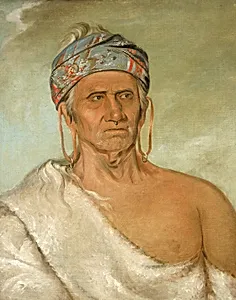
Lay-láw-she-kaw, Goes Up the River, an Aged Chief
1830
Medium
Painting
Classification
Painting
Department
Smithsonian Collection
Museum
Smithsonian American Art Museum
Credit
Smithsonian American Art Museum, Gift of Mrs. Joseph Harrison, Jr.
Accession Number
1985.66.277
Rights
Public Domain
Tags
About this artwork
“The present chief of the [Shawnee] tribe,” George Catlin wrote, “is a very aged, but extraordinary man, with a fine and intelligent head, and his ears slit and stretched down to his shoulders, a custom highly valued in this tribe; which is done by severing the rim of the ear with a knife, and stretching it down by wearing heavy weights attached to it at times, to elongate it as much as possible, making a large orifice, through which, on parades, &c. they often pass a bunch of arrows or quills, ...
Art Historical Context
**Lay-láw-she-kaw, Goes Up the River an Aged Chief** (1830) is a compelling portrait by George Catlin, the pioneering 19th-century artist dedicated to documenting Native American life. Catlin, known for his realistic oil paintings that captured the dignity and customs Indigenous peoples before widespread assimilation, likely created this work at Fort Leavenworth present-day Kansas. As part of his extensive travels among tribes in the 183s, Catlin produced hundreds of portraits to preserve vanishing cultures amid U.S. expansion. The subject is Lay-láw-she-kaw, the elderly chief of the Shawnee tribe, whom Catlin described as an "extraordinary man" with a "fine and intelligent head." A striking feature is his elongated ears, stretched down to his shoulders—a prized Shawnee custom achieved by slitting the ear rim and weighting it to create a large orifice for ornaments like arrows or quills during parades. This detail highlights Catlin's meticulous attention to cultural practices, rendered with empathetic realism that humanizes his sitters. Painted during the era of the Indian Removal Act, this artwork holds historical significance as a vivid record of Shawnee leadership and traditions on the cusp of forced relocation. Today, it resides in the Smithsonian American Art Museum, offering visitors a window into a resilient people's world.
About the Artist
George Catlin · 1796–1872
George Catlin (1796–1872), born in Wilkes-Barre, Pennsylvania, to Putnam Catlin and Polly Sutton—who had been captured by Native Americans during the 1778 Battle of Wyoming—initially pursued a legal career. Trained at Litchfield Law School, he was admitted to the bar in 1819 but abandoned law after two years to study art in Philadelphia in 1823. Self-taught as a portraitist, Catlin quickly gained ...