
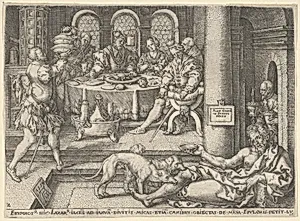
Lazarus at the Rich Man's Gate
Medium
Engraving
Dimensions
Sheet: 3 1/8 × 4 5/16 in. (8 × 11 cm)
Classification
Prints
Department
Drawings and Prints
Museum
Metropolitan Museum of Art, New York, NY
Credit
Gift of Henry Walters, 1917
Accession Number
17.37.227
Rights
Public Domain
Tags
Art Historical Context
Heinrich Aldegrever’s 1554 engraving *Lazarus at the Rich Man’s Gate* captures a pivotal New Testament parable in exquisite miniature form. The small print (just over three by four inches) shows the wealthy man and his companions feasting indoors while the beggar Lazarus waits outside, accompanied by dogs. Through the open doorway we glimpse basins, ewers, and abundant food, underscoring the stark contrast between luxury and poverty that drives the biblical narrative. Aldegrever, one of the so-called “Little Masters” of sixteenth-century Germany, specialized in finely detailed engravings meant for wide circulation. Working in the wake of Albrecht Dürer, he employed precise line work and delicate cross-hatching to convey texture—gleaming metalware, rich fabrics, and expressive faces—within a remarkably compact format. Such prints allowed moral and religious stories to reach broad audiences during the Reformation, when questions of wealth, charity, and salvation were keenly debated. Today the engraving survives as a testament to the power of printmaking to blend devotional instruction with artistic virtuosity, inviting viewers to reflect on social responsibility across centuries.
About the Artist
Heinrich Aldegrever · 1502–1561
Heinrich Aldegrever, born in 1502 in Paderborn, Westphalia, to parents Herman and Katherine Trippenmeker—a family of clog-makers known by the dialect name Trippenmecker—emerged as a multifaceted artist in the German Renaissance. His early training remains undocumented, though he likely apprenticed in a Soest goldsmith's workshop after relocating there around 1525, where he joined the painters' gui...