
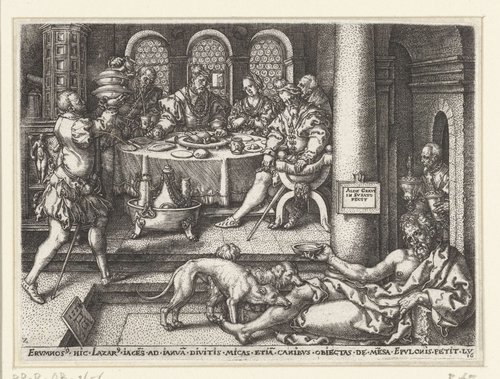
Lazarus bedelt aan de deur van de rijke man
Medium
engraving
Dimensions
80; 108
Rights
Public Domain
About this artwork
plaatrand: hoogte 80 mm x breedte 108 mm
Art Historical Context
**Lazarus Begs at the Door of Rich Man** Hein Aldegrever, 1554 Engraving, 80 × 108 mm Step into the intricate world of 16th-century German printmaking with Heinrich Aldegrever's poignant engraving *Lazarus bedelt aan de deur van rijke man* (Lazarus Begs at the Door of Rich Man). This tiny yet powerful work, measuring just 80 mm high by 108 mm wide, captures a pivotal moment from the biblical parable in Luke 16: Lazarus, the impoverished beggar, pleads at the threshold of a wealthy man's lavish home. Aldegrever, a master engraver from Soest and one of the esteemed "Little Masters," specialized in such diminutive scales, transforming metal plates into detailed narratives that could be widely shared. Created in 1554 amid the Protestant Reformation, the print reflects Northern Renaissance ideals, blending moral allegory with meticulous technique. Aldegrever's engraving process—incising fine lines into a copper plate for inked impressions—allowed for exquisite precision, evident in the contrasts between the beggar's ragged despair and the rich man's opulent indifference. These affordable prints served as visual sermons, urging viewers to ponder charity and divine judgment in an era of social upheaval. This gem highlights engraving's democratic power: small enough for personal devotionals, yet rich in symbolism. Aldegrever produced over 200 such works, making biblical lessons accessible to all, a testament to art's role in shaping faith and ethics during turbulent times.
About the Artist
Heinrich Aldegrever · 1502–1561
Heinrich Aldegrever, born in 1502 in Paderborn, Westphalia, to parents Herman and Katherine Trippenmeker—a family of clog-makers known by the dialect name Trippenmecker—emerged as a multifaceted artist in the German Renaissance. His early training remains undocumented, though he likely apprenticed in a Soest goldsmith's workshop after relocating there around 1525, where he joined the painters' gui...