
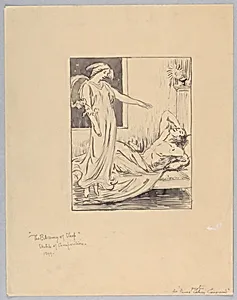
"The Blessing of Sleep," Study for a Poster for Paine's Celery Compound
Classification
graphic design
Department
Smithsonian Collection
Museum
Smithsonian American Art Museum
Credit
Gift of Allyn Cox
Accession Number
1960-83-297
Rights
Public Domain
About this artwork
Research in Progress
Art Historical Context
Kenyon Cox (1856–1919), a prominent American artist trained in the classical Beaux-Arts tradition in Paris, created *The Blessing of Sleep* in 1899 as a study for a poster promoting's Celery Compound. patent medicine, popular in the late 19 century, promised relief from nervous exhaustion and insomnia through celery-based tonics—a common pitch in an era of rapid industrialization and urban stress. Cox, known for his murals and illustrations blending neoclassical idealism with modern commercial art, captured the theme of restorative slumber, reflecting the growing cultural fascination with health and vitality. As graphic design from the poster art boom of the 1890s, this preparatory work highlights the era's innovative use of bold imagery to sell consumer products. Posters like this one, often produced via chromolithography, transformed streets into vibrant ad spaces, influencing public taste and commerce. Cox's involvement underscores how fine artists elevated advertising, merging aesthetic refinement with persuasive messaging. Though the exact medium remains unknown, the piece's placement in the Smithsonian American Art Museum—gifted by Cox's son Allyn—celebrates its role in American visual culture. Visitors can appreciate how it bridges art and everyday life, inviting reflection on how we once visualized wellness.