
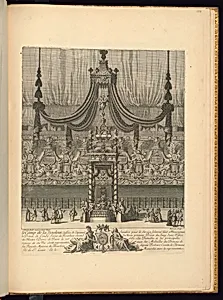
Le Camp de la Douleur
Classification
Bound print
Department
Smithsonian Collection
Museum
Smithsonian American Art Museum
Credit
Purchased for the Museum by the Advisory Council
Accession Number
1921-6-201-122
Rights
Public Domain
About this artwork
Research in Progress
Art Historical Context
**Le Camp de la Douleur** (The Camp of Pain), created by Jean Berain the elder in 1711, offers a glimpse into the opulent world of late Baroque France. Berain (1640–1711), a master designer and engraver at the court of Louis XIV, was renowned for his intricate ornamental motifs—swirling arabesques, theatrical grotesques, and fantastical scenes that adorned everything from opera sets to royal tapestries. As designer to the Paris Opéra, his work bridged decorative arts and performance, influencing the emerging Rococo style with its playful elegance and dramatic flair. This piece, dated to the year of his death, captures the height of his career amid the grandeur of Versailles. Classified as a bound print in the Smithsonian American Art Museum's collection, *Le Camp de la Douleur* likely belongs to a series of engraved designs, where intricate line work on paper allowed for precise replication and binding into albums for collectors and artists. The evocative title suggests an allegorical or theatrical tableau, evoking suffering or torment in a stylized, courtly manner—perhaps inspired by opera librettos or mythological narratives popular in Berain's circles. Though research continues, its acquisition by the museum's Advisory Council underscores its value as a rare survivor of 18th-century French print culture, highlighting how prints democratized elite design for wider audiences. A testament to Berain's enduring legacy, it invites us to imagine the Sun King's glittering court alive with imagination and art.