
Le Moulin de Saint-Ouen
1845, printed 1965
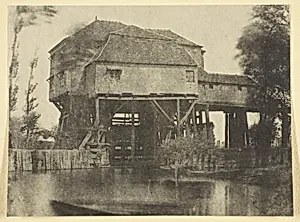
Medium
Gelatin silver print, No. 9 from the portfolio "Bayard: XXV Calotypes, 1842-1850" (1965)
Dimensions
Image/paper/mount: 17.1 × 23 cm (6 3/4 × 9 1/16 in.)
Classification
photographic process
Department
Photography and Media
Museum
Art Institute of Chicago
Accession Number
23771
Rights
Public Domain
Art Historical Context
Hippolyte Bayard, a pioneering French photographer, created *Le Moulin de Saint-Ouen* in 1845 during the earliest years of the medium. One of photography’s inventors alongside Daguerre and Talbot, Bayard experimented with paper-based processes at a time when most practitioners favored metal plates. This view of a windmill on the outskirts of Paris captures the quiet, everyday landscapes that early photographers found compelling subjects for testing the new technology’s ability to record light and texture. The work on view is a gelatin silver print made in 1965 from Bayard’s original calotype negative and issued as part of the portfolio *Bayard: XXV Calotypes, 1842–1850*. The calotype process, which Bayard helped refine, produced soft, matte images prized for their atmospheric quality and capacity for subtle tonal gradations. Measuring just 17.1 × 23 cm, the print demonstrates how modest scale could still convey a strong sense of place and light. Today the photograph resides in the Art Institute of Chicago’s Department of Photography and Media, where it helps visitors appreciate Bayard’s inventive spirit and the rapid evolution of photographic techniques in the nineteenth century.
About the Artist
Hippolyte Bayard · 1801–1887
Hippolyte Bayard (1801–1887) was a French civil servant and artist who holds a remarkable, if bittersweet, place in the history of photography: he was one of the independent inventors of the photographic process in the late 1830s, developing his own direct positive paper print method at virtually the same moment that Louis Daguerre and William Henry Fox Talbot were arriving at their own solutions ...