
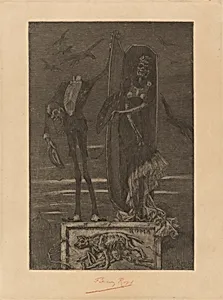
Le Vice suprème: Frontispiece
1884
Medium
etching on wove paper
Dimensions
plate: 23.5 x 34.2 cm (9 1/4 x 13 7/16 in.) sheet: 15.8 x 26.9 cm (6 1/4 x 10 9/16 in.)
Classification
Department
CG-E
Museum
National Gallery of Art, Washington, D.C.
Credit
Gift of Frank Anderson Trapp
Accession Number
2003.118.23
Rights
Public Domain
Art Historical Context
Félicien Rops, a Belgian artist renowned for his provocative explorations of eroticism, decadence, the macabre, created *Le Vice suprême Frontispiece* in 1884. This etching served as the introductory image for Rops's infamous series *Le Vice suprême*, suite of prints delving into themes of sin, death, and human vice during the fin-de-siècle era. As a key figure in Symbolism and the Decad movement, Rops challenged Victorian moralities with bold, satirical imagery that blended sensuality and morbidity, reflecting the cultural anxieties of late 19th-century Europe amid industrialization and shifting social norms. Executed as an etching on wove paper—a smooth, high-quality support ideal for capturing intricate lines and tonal contrasts—the work measures 23.5 x 34.2 cm on the plate, with the sheet slightly trimmed to 15.8 x 26.9 cm. Etching allowed Rops to achieve exquisite detail and dramatic depth through acid-bitten lines, a technique he mastered to evoke psychological intensity. Housed in the National Gallery of Art's Prints department (CG-E) as a gift from Frank Anderson Trapp, this piece exemplifies the technical virtuosity of 19th-century printmaking, which democratized access to daring art beyond elite paintings. Today, *Le Vice suprême: Frontispiece* stands as a testament to Rops's enduring influence on modern graphic arts, inviting visitors to confront the shadowy undercurrents of human desire and mortality in a single, haunting image.
About the Artist
Félicien Rops · 1833–1898
Félicien Rops, born Félicien Victor Joseph Rops on July 7, 1833, in Namur, Belgium, to a prosperous textile manufacturing family, displayed prodigious artistic talent from youth. The only child of Nicholas Rops and Sophie Maubile, he received private tutoring until age ten, followed by education at a Jesuit school in Namur (1843–1848), the Athénée Royal de Namur, and the Academy of Fine Arts there...