
Le voile
1860s
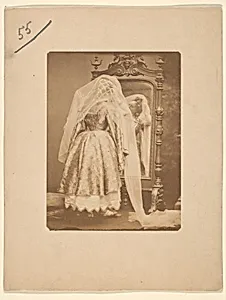
Medium
Albumen silver print from glass negative
Classification
Photographs
Department
Photographs
Museum
Metropolitan Museum of Art, New York, NY
Credit
David Hunter McAlpin Fund, 1975
Accession Number
1975.548.55
Rights
Public Domain
Tags
Art Historical Context
**Le Voile (The Veil)**, a captivating albumen silver print from a negative by Pierre-Louis Pierson, dates to the 1860s and exemplifies the elegance of mid-19th-century French portrait photography. Captured during the opulent Second Empire era, this intimate portrait features a woman partially veiled, her reflection possibly engaging with a mirror—a motif that adds layers of mystery and self-awareness. Pierson, a master photographer linked to high-society studios, specialized in such refined images, often highlighting fashion and femininity for elite clientele. The albumen silver process, using egg whites to coat paper for exceptional detail and warm tones, was the gold standard of the time, enabling widespread production of cartes de visite—small portraits that fueled a photographic craze across Europe. This medium's crisp clarity brings out subtle textures in fabrics and expressions, making *Le Voile* a window into Victorian-era ideals of beauty and allure. Housed in The Metropolitan Museum of Art's Photographs Department (David Hunter McAlpin Fund, 1975), the work underscores photography's rise as both art and social document, blending portraiture with emerging fashion iconography. Visitors will appreciate its timeless poise, inviting reflection on how veils and mirrors symbolized enigma and identity in 19th-century women's portraits.
About the Artist
Pierre-Louis Pierson · 1822–1913
Pierre-Louis Pierson (1822–1913) was a pioneering French portrait photographer whose career spanned the formative years of the medium. Born on December 13, 1822, in Hinckange in the Moselle department, Pierson developed an early fascination with photography during the 1840s, as the daguerreotype was still in its infancy. His early life and formal training remain sparsely documented, but by 1844, h...