
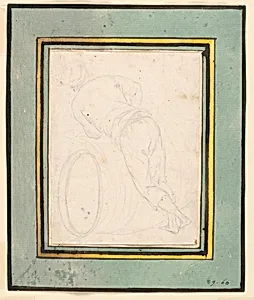
Leaning Man
Classification
figures
Department
Smithsonian Collection
Museum
Smithsonian American Art Museum
Credit
Museum purchase through gift of various donors and from Eleanor G. Hewitt Fund
Accession Number
1938-88-4458
Rights
Public Domain
About this artwork
Research in Progress
Art Historical Context
Luigi Vanvitelli, an Italian architect and draftsman active during the 18th century, created "Leaning Man" sometime between 1700 and 1773. Best known for designing the majestic Royal Palace of Caserta, Vanvitelli in the late Baroque tradition while foreshadowing neoclassical restraint. This figure study, now part of the Smithsonian American Art Museum’s holdings, reflects his interest in human anatomy and posture—qualities that often informed the sculptural details of his grand architectural projects. Acquired through the generosity of multiple donors and the Eleanor G. Hewitt Fund, the work invites viewers to consider how artists of Vanvitelli’s era used the human form to convey balance, tension, and movement. Though its exact medium remains under study and curatorial research is ongoing, the piece stands as a quiet testament to the period’s blend of technical precision and expressive grace. Visitors are encouraged to return as new findings emerge.