
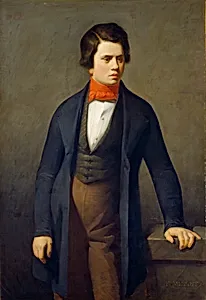
Leconte de Lisle
c. 1840/1841
Medium
oil on canvas
Dimensions
overall: 117 x 81 cm (46 1/16 x 31 7/8 in.) framed: 135.9 x 99.7 cm (53 1/2 x 39 1/4 in.)
Classification
Painting
Department
CF
Museum
National Gallery of Art, Washington, D.C.
Credit
Chester Dale Collection
Accession Number
1963.10.42
Rights
Public Domain
Art Historical Context
This striking portrait by Jean-François Millet captures the young poet Charles Marie René Leconte de Lisle around 1840–1841, when both artist and subject were in their early twenties. Painted in oil on canvas, the work measures over four feet tall, giving the figure a commanding presence. Millet, who would later become celebrated for his realist scenes of rural life as a founder of the Barbizon school, here demonstrates his early skill in formal portraiture, a genre he pursued to support himself while establishing his career in Paris. The painting reflects the cultural ferment of mid-nineteenth-century France, where literature and the visual arts often intersected. Leconte de Lisle would go on to lead the Parnassian poets, advocating for impersonal, classically inspired verse, yet this early likeness shows him at the threshold of that journey. Millet’s careful attention to pose and expression suggests a thoughtful study of character rather than mere likeness. Now part of the Chester Dale Collection at the National Gallery of Art, the canvas offers visitors a rare glimpse of Millet’s formative years before his iconic peasant subjects. Its generous scale and rich oil technique invite close looking, revealing the artist’s developing command of light and form that would define his later masterpieces.
About the Artist
Jean-François Millet · 1814–1875
Jean-François Millet (1814-1875) was a French painter and one of the founders of the Barbizon school, whose dignified depictions of peasant laborers transformed how art could represent rural life. His monumental images of sowers, gleaners, and field workers elevated common people to subjects previously reserved for mythological or historical figures, making him a pivotal figure in the development ...