
Leda en de zwaan
c. 1544 - c. 1600
Medium
engraving
Dimensions
270; 395
Rights
Public Domain
About this artwork
height 270 mm x width 395 mm
Art Historical Context
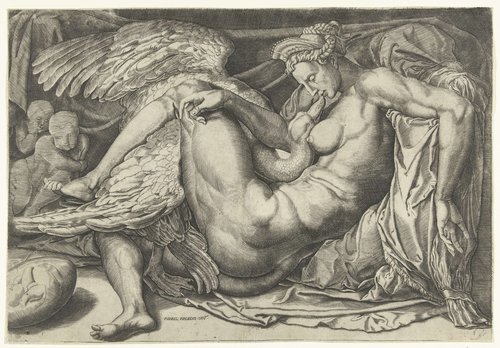
**Leda en de Zwaan (Leda and the Swan This captivating engraving, created by an anonymous artist between circa 1544 and 1600, depicts the timeless myth of Leda, a Spartan queen, entwined with Zeus in the form of a swan. Rooted in ancient Greek mythology, the subject was a favorite in Renaissance art for its blend of eroticism and divine narrative, symbolizing beauty, desire, and the gods' capricious interventions in human affairs. The work's Dutch title hints at its Northern European origins, where such mythological scenes flourished amid the era's humanist revival. As an engraving—a precise intaglio technique where lines are incised into a metal plate and inked to produce detailed prints—this piece exemplifies 16th-century printmaking's revolutionary impact. Measuring 270 mm high by 395 mm wide, its landscape format allowed for intricate compositions that could be widely reproduced and collected, democratizing access to sophisticated imagery beyond elite paintings. Anonymous engravers like this one often drew from famous prototypes by masters such as Michelangelo or Marcantonio Raimondi, adapting them for popular dissemination. This artwork highlights the cultural allure of sensual mythology during Europe's print boom, bridging classical antiquity with early modern tastes. Visitors will appreciate its technical finesse, where fine lines evoke feathers, flesh, and fluidity, inviting reflection on art's power to immortalize forbidden passions.
About the Artist
anonymous
In the vast tapestry of art history, "Anonymous" stands not as a singular individual but as a collective designation for countless unidentified creators whose works have endured across millennia. These artists, spanning prehistoric cave painters to medieval illuminators and folk craftsmen, produced the foundational layers of human visual culture. Prior to the Renaissance, when individual fame emer...