
Lesbia Amaryllis
1801 to 1825
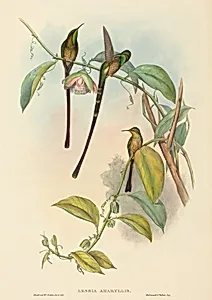
Medium
hand-colored lithograph on wove paper
Dimensions
sheet: 56 x 38.7 cm (22 1/16 x 15 1/4 in.)
Classification
Department
CG-E
Museum
National Gallery of Art, Washington, D.C.
Credit
Collection of Dr. and Mrs. George Benjamin Green
Accession Number
1991.163.56
Rights
Public Domain
Art Historical Context
This hand-colored lithograph, created between 1801 and 1825 by John Gould and H.C. Richter, exemplifies the golden age of natural history illustration. Gould, a prominent British ornithologist and artist, collaborated closely with Richter to produce detailed studies of birds from around the world. Their partnership helped bring scientific accuracy and artistic beauty together, making complex avian subjects accessible to scholars and the public alike through printed works. The medium itself is noteworthy. Lithography, still relatively new at the time, allowed for fine lines and subtle textures that were then enhanced by hand-coloring. This technique gave each impression a unique vibrancy while enabling wider distribution than paintings alone could achieve. Measuring roughly 22 by 15 inches, the sheet size was well suited for both study and display in private collections. Today, works like *Lesbia Amaryllis* at the National Gallery of Art remind us how 19th-century printmaking advanced both art and science. They continue to delight viewers with their precision and color, bridging the worlds of natural observation and aesthetic appreciation.
About the Artist
John Gould and H.C. Richter
John Gould (1804–1881) and Henry Constantine Richter (1821–1902) formed one of the most productive and celebrated partnerships in the history of natural history illustration. Gould, an English ornithologist and publisher of extraordinary ambition, built a career on the production of lavishly illustrated folio volumes documenting the birds of Britain, Europe, Australia, Asia, and the Americas. Thou...