
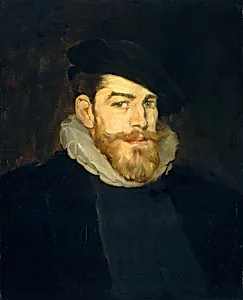
Leslie Pease Barnum
1876
Medium
oil on canvas
Dimensions
overall: 56 x 46 cm (22 1/16 x 18 1/8 in.) framed: 73.7 x 64.1 x 4.1 cm (29 x 25 1/4 x 1 5/8 in.)
Classification
Painting
Department
CAB
Museum
National Gallery of Art, Washington, D.C.
Credit
Andrew W. Mellon Collection
Accession Number
1942.8.3
Rights
Public Domain
Art Historical Context
Frank Duveneck's *Leslie Pease Barn* (1876) is a compelling oil-on-canvas portrait that captures the intensity of late 19th-century American. Measuring 56 x 46 cm, this intimate work from the National Gallery of Art Andrew W. Mellon Collection Duveneck's mastery during his formative years in Munich, where he absorbed the dramatic lighting and bold brushwork of the city's realist tradition, influenced by artists like Wilhelm Leibl. Duveneck (1848–1919), an influential Cincinnati-born painter and teacher, returned from Europe with a distinctive style marked by vigorous, loose strokes and deep shadows—hallmarks of his "Duveneck Boys" followers. Here, the oil medium allows for rich texture and luminosity, drawing viewers into the subject's gaze and evoking psychological depth reminiscent of Rembrandt. Painted amid Duveneck's rise as a transatlantic force, it reflects the era's fascination with character studies amid rapid industrialization. This piece highlights Duveneck's bridge between European techniques and American portraiture, offering visitors a window into Gilded Age individuality. Its presence in the NGA underscores his enduring legacy in American art.
About the Artist
Frank Duveneck · 1848–1919
Frank Duveneck (1848–1919) was an American painter, etcher, and teacher whose dark, bravura style made him one of the most celebrated and influential American artists of the late nineteenth century. Born in Covington, Kentucky, he showed early artistic promise and eventually made his way to Munich, where he studied at the Royal Academy of Fine Arts under Wilhelm von Diez. Munich's artistic culture...