
明/清 王鐸 書札 冊頁|Letter
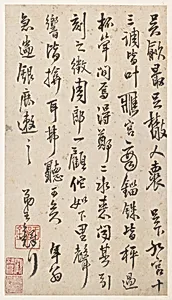
Medium
Album leaf; ink on gold-flecked paper
Dimensions
10 3/4 x 6 in. (27.3 x 15.2 cm)
Classification
Calligraphy
Culture & Period
China · late Ming (1368–1644)–early Qing (1644–1911) dynasty
Department
Asian Art
Museum
Metropolitan Museum of Art, New York, NY
Credit
Bequest of John M. Crawford Jr., 1988
Accession Number
1989.363.118
Rights
Public Domain
Art Historical Context
This exquisite album leaf, a personal letter (shuzha) by the renowned Ming dynasty calligrapher Wang Duo, dates to the late Ming (1368–1644) or early Qing (1644–1911) period, a time of profound political upheaval in China as the Ming fell to the Manchu Qing. Wang Duo, a loyalist scholar-official who famously refused to serve the new dynasty and took his own life in protest, infused his calligraphy with raw emotion and individuality, reflecting the era's cultural resistance and personal turmoil. Rendered in bold ink strokes on luxurious gold-flecked paper, this 10 3/4 x 6 in. (27.3 x 15.2 cm) leaf exemplifies the album format popular among literati for preserving intimate writings. The shimmering gold flecks enhance the ink's dynamism, creating a tactile contrast that elevates calligraphy from mere script to high art. Wang's style—vigorous, expressive, and unbound by rigid convention—bridges clerical and running scripts, showcasing his mastery in capturing the caller's spirit. In Chinese culture, such letters were cherished as windows into the artist's soul, blending literature, philosophy, and aesthetics. Bequeathed to the Metropolitan Museum of Art by John M. Crawford Jr. in 1988, this piece invites visitors to ponder the intersection of artistry and history amid dynasty's end.
About the Artist
Wang Duo (Chinese) · 1592 –1652
Chinese, 1592–1652