
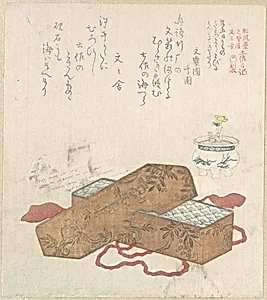
Letter-Box with Letter and Potted Flower
19th century
Medium
Woodblock print (surimono); ink and color on paper
Dimensions
8 1/8 x 7 1/4 in. (20.6 x 18.4 cm)
Classification
Prints
Culture & Period
Japan · Edo period (1615–1868)
Department
Asian Art
Museum
Metropolitan Museum of Art, New York, NY
Credit
H. O. Havemeyer Collection, Bequest of Mrs. H. O. Havemeyer, 1929
Accession Number
JP2072
Rights
Public Domain
Tags
Art Historical Context
Kubo Shunman's *Letter-Box with Letter Potted Flower* is delightful 19th-century woodblock print from Japan's Edo period (16151868), exemplifying the intimate artistry of *surimono*. These commissioned prints, often produced for poetry gatherings or New Year's celebrations, were luxurious limited editions featuring vibrant colors, fine embossing, and sometimes mica or gold accents. Measuring just 8 1/8 x 7 1/4 inches, this ink-and-color-on-paper work captures a simple yet evocative still life: a wooden letter-box holding a missive beside a potted flower, evoking themes of communication, transience, and natural beauty central to Japanese aesthetics. Shunman (1777–1845), a versatile ukiyo-e master and poet, blended realism with poetic whimsy in his prints, often incorporating kyōka verse. Here, the meticulous composition highlights everyday objects with exquisite detail—the texture of the box, the delicate petals—showcasing advanced woodblock techniques like *karazuri* (gauffrage) for tactile depth. Surimono like this were status symbols for literati circles, bridging art and literature. Part of the Metropolitan Museum of Art's H.O. Havemeyer Collection, this piece offers a window into Edo urban culture, where such prints celebrated quiet moments amid a bustling world. A charming gem for admirers of Japanese printmaking! (198 words)
About the Artist
Kubo Shunman · 1757–1820
Japanese, 1757–1820