
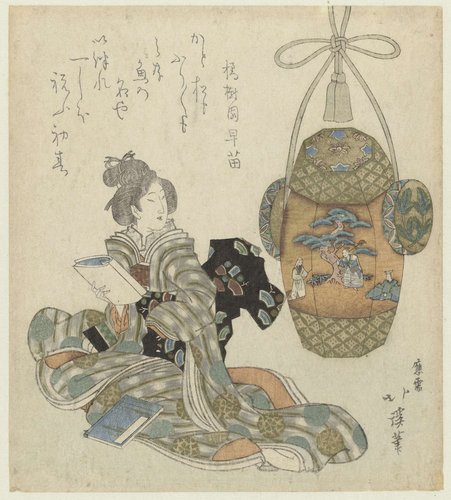
Lezende vrouw
ca. 1815 - ca. 1820
Medium
nishikie, with metallic pigments
Dimensions
206; 183
Rights
Public Domain
About this artwork
Een surimono is een luxe uitgevoerde prent waarop beeld met één of meerdere gedichten gecombineerd is. Bij het drukken van een surimono werd vaak gebruik gemaakt van dikker papier, blinddruk en metaal pigmenten, zoals koper- en zilverpoeder. De prenten werden vaak in opdracht van dichters gemaakt en als exclusief geschenk aan vrienden en relaties gegeven.
Art Historical Context
**Lezende vrouw (Reading Woman)** *Totoya Hokkei, ca. 1815–1820* *Nishikie woodblock with metallic pigments, 206 × 183 mm* In the vibrant world of Edo-period Japan (1603–1868), Totoya Hokkei, a skilled ukiyo-e artist and pupil the famed Katsushika Hokusai, created this intimate *nishikie*—a "brocade picture" renowned for its rich, multicolored woodblock printing. Depicting a woman absorbed in reading, the print exemplifies Hokkei's mastery of delicate figures and everyday elegance, capturing a quiet moment of scholarly repose amid the floating world's fleeting pleasures. This work is a luxurious *surimono*, a privately commissioned genre blending artistry with poetry. Printed on thicker paper with embossed effects and shimmering metallic pigments like copper and silver powders, *surimono* were exclusive New Year's gifts from poets to cherished friends. Far from mass-produced, they highlight elite cultural exchange, where visual beauty amplified lyrical verse—though the specific poems here remain part of its poetic mystery. At just 20 cm tall, its petite scale invites close admiration, revealing the innovative techniques that elevated Japanese printmaking to high art.
About the Artist
Totoya Hokkei · 1780–1850
Totoya Hokkei (魚屋 北渓, 1780–1850), born Iwakubo Tatsuyuki in Edo (modern Tokyo), began his life as a humble fishmonger in the Yotsuya Samegahashi district, a trade reflected in his art name "Totoya," meaning fish shop. He transitioned to art through rigorous training, first studying under Kanō Yōsen'in Korenobu, head of the Kobikichō branch of the prestigious Kanō school, where he honed landscape p...