
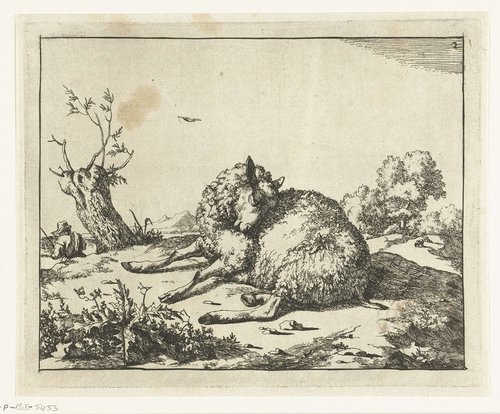
Liggend schaap, bij knotwilg
1660
Medium
etching
Dimensions
147; 118
Rights
Public Domain
About this artwork
width 147 mm
Art Historical Context
**Liggend schaap, bij knotwilg (Reclining Sheep, by Pollarded Willow)** *Marcus de Bye, 1660, etching, 118 × 147 mm* In this delicate etching, Dutch artist Marcus de Bye captures a serene pastoral moment: a sheep reclining peacefully beside a gnarled knotwilg, or pollarded willow tree. Created in 1660 during the Dutch Golden Age, the work reflects the era's fascination with the natural world and rural life. De Bye, active in the mid-17th century, specialized in intimate animal studies, rendering the sheep's soft wool and the tree's textured bark with exquisite precision on this small plate. Etching, a favored technique of the time, allowed de Bye to achieve fine, expressive lines that mimic the textures of fur and foliage. Popularized by masters like Rembrandt, it enabled affordable reproduction of detailed nature scenes, bringing the tranquility of the countryside to urban collectors. At just 118 mm high and 147 mm wide, the print invites close viewing, emphasizing quiet observation over grandeur. This piece exemplifies the Dutch Golden Age's celebration of everyday beauty, where humble subjects like sheep and willows symbolized harmony with nature. De Bye's work, though lesser-known today, contributed to the rich tradition of animalier prints, offering visitors a window into 17th-century Holland's artistic reverence for the land.