
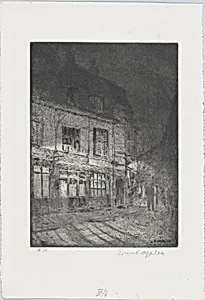
Lille: Liebesgässchen
Medium
Etching
Dimensions
plate: 7 x 5 1/16 in. (17.8 x 12.8 cm) sheet: 10 1/16 x 6 7/8 in. (25.5 x 17.5 cm)
Classification
Prints
Department
Drawings and Prints
Museum
Metropolitan Museum of Art, New York, NY
Credit
Gift of M.P. Epstein, 1967
Accession Number
67.671.12(1)
Rights
Public Domain
Tags
Art Historical Context
" Lille: Liebesgässchen" is a delicate 1916 etching by Ernst Oppler and Ludwig Möller that portrays a narrow street lined with buildings in the northern French city of Lille. The compact plate size—just seven by inches—invites close looking, revealing the fine lines and subtle tonal variations that etching excels at capturing. The work belongs to the Metropolitan Museum of Art’s Department of Drawings and Prints, where it entered the collection as a gift in 1967. Etching’s ability to translate architectural detail into crisp, atmospheric lines made it a favored medium for early-twentieth-century printmakers interested in urban character. Here, the artists focus on the intimate scale of the streetscape, allowing the textures of façades and the play of light and shadow to suggest a lived-in neighborhood rather than a grand monument. Created during World War I, the print offers a quiet record of Lille’s historic fabric at a moment when the city was under German occupation. Its presence in the museum today reminds visitors how graphic works can preserve both the appearance and the mood of places shaped by larger historical forces.
About the Artist
Ernst Oppler|Ludwig Möller · 1867–1929
Comment on works: interiors; portrait; landscape