
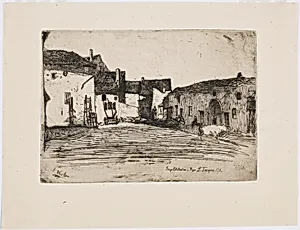
Liverdun
Classification
Department
Smithsonian Collection
Museum
Smithsonian American Art Museum
Credit
Gift of Charles Lang Freer
Accession Number
F1898.212
Rights
Public Domain
Tags
About this artwork
3
Art Historical Context
**Liverdun** (1858) is an early etching by James McNeill Whistler, the American-born artist renowned for his elegant, atmospheric style and advocacy of "art for art's sake." Created during Whistler's travels in France, this print captures the quaint architecture of Liverdun, a village near Nancy, with a serene cow adding a touch of pastoral charm. At just 24 years old, Whistler was experimenting with printmaking, drawing inspiration from the French countryside and etching's delicate lines to evoke subtle mood and light. Etching, a meticulous intaglio process where acid etches designs into a metal plate, allowed Whistler to achieve fine, expressive detail—foreshadowing his later masterpieces like the *Nocturnes*. This work belongs to his "French Set," showcasing his shift from realist influences toward Aestheticism, prioritizing beauty over narrative. Its inclusion in American Art highlights Whistler's transatlantic impact, bridging U.S. and European traditions. A cherished piece in the Smithsonian American Art Museum, **Liverdun** was gifted by industrialist Charles Lang Freer, whose vast Whistler collection forms a cornerstone of the museum. Visitors appreciate its quiet poetry, inviting reflection on 19th-century wanderlust and the artistry of everyday scenes. (198 words)