
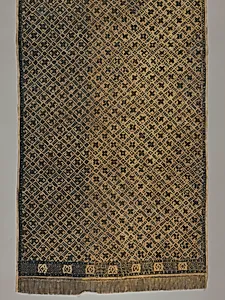
Long sarong (kain panjang)
19th century
Medium
printed, dyed & painted textiles
Classification
printed, dyed & painted textiles
Department
Smithsonian Collection
Museum
Smithsonian American Art Museum
Credit
Gift of Alan L. Wolfe
Accession Number
1961-115-2
Rights
Public Domain
About this artwork
Research in Progress
Art Historical Context
This elegant *long sarong (kain panjang)* from the 19th century exemplifies the rich tradition of Southeast Asian textile arts, likely originating from Indonesia or Malaysia. As a versatile garment, the kain panjang was wrapped around the body as a sarong, serving both practical and ceremonial purposes in daily life. Worn by men and women alike, it reflected social status, regional identity, and cultural narratives through its intricate designs. Housed in the Smithsonian American Art Museum's Smithsonian Collection—thanks to the generous gift of Alan L. Wolfe—this piece highlights the global exchange of artistic techniques during the colonial era. Crafted from printed, dyed, and painted textiles, the sarong showcases labor-intensive methods such as block printing, resist-dyeing (possibly batik or tritik), and hand-painting. These processes allowed artisans to create vibrant patterns with symbolic motifs—floral, geometric, or mythical—that conveyed stories of nature, fertility, and protection. The medium's significance lies in its impermanence and skill: natural dyes from indigo, turmeric, and bark demanded precise application to withstand wear and washing, preserving cultural heritage in fabric form. Though research on this specific sarong is ongoing, it invites us to appreciate the anonymous mastery of textile weavers, whose innovations influenced global fashion and design. A testament to everyday artistry, it reminds visitors of textiles' power as wearable history.
About the Artist
Unknown
The artist designated as "Unknown" in our virtual museum's collection exemplifies a poignant chapter in art history: creators whose identities have faded into obscurity despite the enduring power of their work. With only one known artwork attributed to them in our holdings, this figure represents countless anonymous hands that shaped visual culture across centuries. Museums worldwide, including th...