
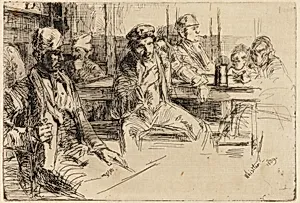
Longshore men
Classification
Department
Smithsonian Collection
Museum
Smithsonian American Art Museum
Credit
Gift of Charles Lang Freer
Accession Number
F1890.5
Rights
Public Domain
Tags
About this artwork
In Whistler's day, genteel people who could afford to purchase etchings generally avoided unnecessary trips to working-class sections of cities. For such people, Whistler's etchings of the Thames riverfront provided unusually intimate glimpses of what a contemporary critic described as "that class of hard-fisted, square-shouldered, solid-faced men, on whom the odour of tar and tobacco is equally important."
Art Historical Context
James McNeill Whistler, the American-born artist renowned for his elegant Aestheticism and masterful etchings, captured the gritty vitality of London's Thames riverfront in *Longshoremen* (1859). This print belongs to his early Thames Set, a series that showcased his technical prowess in etching—a process where acid bites into a metal plate to create fine, intricate lines. Whistler's realistic depictions marked a departure from his later impressionistic nocturnes, offering vivid portraits of everyday laborers amid the bustling docks. In Victorian England, affluent collectors who bought etchings like this one rarely ventured into working-class districts. Whistler's work provided a rare, intimate window into that world, as one critic noted: "that class of hard-fisted, square-shouldered, solid-faced men, on whom the odour of tar and tobacco is equally important." These longshoremen—dock workers loading and unloading ships—embody the industrial era's workforce, their sturdy forms evoking the Thames' economic pulse. A gift from collector Charles Lang Freer to the Smithsonian American Art Museum, *Longshoremen* highlights Whistler's influence bridging American and British art. It invites us to appreciate not just artistic skill, but the humanity in overlooked lives.