
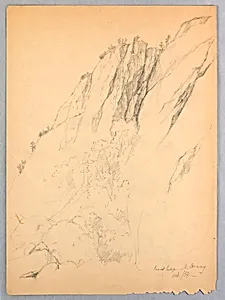
Lowest Ledge, North Conway, New Hampshire
October 1854
Classification
landscapes
Department
Smithsonian Collection
Museum
Smithsonian American Art Museum
Credit
Bequest of Erskine Hewitt
Accession Number
1942-50-474
Rights
Public Domain
About this artwork
Research in Progress
Art Historical Context
**Lowest Ledge, North Conway, New Hampshire** *Daniel Huntington, American, 1816–1906, October 1854* Nestled in the dramatic White Mountains of New Hampshire, *Lowest Ledge, North Conway* captures the rugged beauty of a cherished 19th-century artist retreat. Painted in October 1854 by Daniel Huntington, a versatile American artist known for his early landscapes before turning to portraits and historical scenes, this work reflects the era's fascination with the American wilderness. North Conway was a hub for painters seeking inspiration from nature's sublime power, much like Huntington's Hudson River School contemporaries. As a landscape classification from the Smithsonian American Art Museum's collection—bequeathed by Erskine Hewitt—this piece embodies mid-19th-century Romanticism, celebrating the untamed Northeast as a symbol of national identity amid rapid industrialization. Though the medium remains under research, Huntington's on-site sketching in autumn likely highlights vibrant foliage and rocky ledges, evoking tranquility and grandeur. Visitors, imagine standing at this "lowest ledge," where earth's raw forms meet seasonal splendor—a timeless invitation to ponder America's natural heritage. (178 words)