
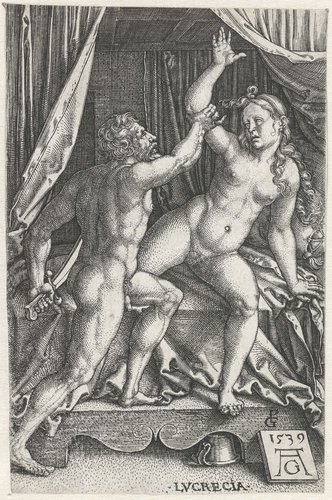
Lucretia en Sextus Tarquinius
Medium
engraving
Dimensions
77; 118
Rights
Public Domain
About this artwork
blad: hoogte 118 mm x breedte 77 mm
Art Historical Context
In the intimate engraving *Lucretia en Sextus Tarquinius* (1539), German artist Heinrich Aldegre captures a pivotal moment from ancient Roman legend. Aldegrever, a member of the "Little MastersRenaissance printmakers renowned for their exquisitely detailed small-scale works—depicts the tragic encounter between the virtuous Lucretia and tyrannical Sextus Tarquinius, son of Rome's last king. This scene alludes to Lucretia's rape, her subsequent suicide, and the spark that ignited the Roman Republic, a story that resonated deeply in 16th-century Europe as a symbol of chastity, justice, and resistance to oppression. Created as a precise engraving on a modest plate (118 mm × 77 mm), the work exemplifies the technical virtuosity of the medium. Aldegrever's mastery of burin incisions on copper allowed for intricate line work, rich tonal contrasts, and narrative clarity in a portable format. Engravings like this were revolutionary, enabling affordable dissemination of classical myths and moral tales across Northern Europe, influencing collectors, artists, and reformers alike. Aldegrever's piece blends Gothic precision with emerging Renaissance humanism, inviting viewers to ponder timeless themes of power and integrity. A gem for any print enthusiast, it showcases how a tiny image could carry monumental cultural weight.
About the Artist
Heinrich Aldegrever · 1502–1561
Heinrich Aldegrever, born in 1502 in Paderborn, Westphalia, to parents Herman and Katherine Trippenmeker—a family of clog-makers known by the dialect name Trippenmecker—emerged as a multifaceted artist in the German Renaissance. His early training remains undocumented, though he likely apprenticed in a Soest goldsmith's workshop after relocating there around 1525, where he joined the painters' gui...