
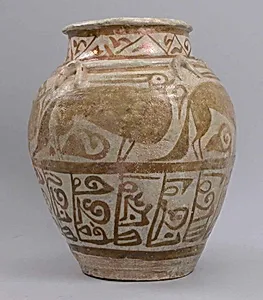
Luster Jar with Hares (?) and Inscribed Words
Unknown Artist
10th century
Medium
Earthenware; luster-painted on opaque white glaze
Dimensions
H. 9 9/16 in. (24.3 cm)
Classification
Ceramics
Department
Islamic Art
Museum
Metropolitan Museum of Art, New York, NY
Credit
Gift of Frederic M. Chacker, 1979
Accession Number
1979.520
Rights
Public Domain
Tags
Art Historical Context
This exquisite 10th-century luster jar, hailing from the Islamic world, exemplifies the pinnacle of medieval ceramic artistry. Crafted during a golden age of Islamic culture—likely in regions like Iraq or Persia under Abbasid or Fatimid patronage—such jars were prized luxury vessels, blending functionality with opulent decoration. Standing at just under 10 inches tall, this earthenware piece from the Metropolitan Museum of Art Islamic Art collection was generously gifted in 1979, offering visitors a tangible link to a vibrant era of scientific, artistic, and commercial flourishing. The jar's medium is a marvel of innovation: earthenware coated in an opaque white glaze, then adorned with luster-painting. This technique, developed in the 9th century, involved applying metallic oxides over the fired glaze and refiring in a low-oxygen kiln to produce a shimmering, iridescent gold or coppery glow—mimicking costly metalwork and rivaling Chinese porcelain. It marked a technical breakthrough, allowing artisans to create luminous effects on humble clay, elevating ceramics to high art. Adorned with motifs of hares (or hare-like figures) and inscribed words, the jar reflects Islamic decorative traditions favoring dynamic animals symbolizing vitality and nature, alongside calligraphic text that might convey poetry, blessings, or ownership marks. These elements highlight the culture's reverence for beauty in everyday objects, making this jar not just a container, but a poetic testament to 10th-century ingenuity.