
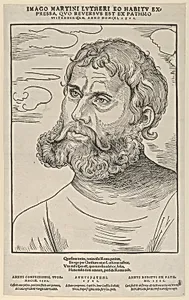
Luther as 'Junker Jorg'
Medium
Woodcut; second state of four (Hollstein)
Dimensions
Sheet: 14 3/16 × 8 7/8 in. (36 × 22.5 cm)
Classification
Prints
Department
Drawings and Prints
Museum
Metropolitan Museum of Art, New York, NY
Credit
Harris Brisbane Dick Fund, 1927
Accession Number
27.54.27
Rights
Public Domain
Tags
Art Historical Context
In 1522, Lucas Cranach the Elder, a leading German Renaissance artist and close ally of Martin Luther, created this striking woodcut print titled *Luther as 'Junker Jörg'*. The second state of four (as cataloged by Hollstein), it measures 14 3/16 × 8 7/8 inches and captures Luther in disguise as a rugged knight, complete with sword, feathered hat, and chainmail. Cranach's bold, expressive style—hallmarks of Northern Renaissance printmaking—made such images affordable and widely distributable, fueling the Protestant Reformation. The portrait commemorates Luther's daring escape in 1521 after defying the Holy Roman Empire at the Diet of Worms. Hiding at Wartburg Castle under the pseudonym "Junker Jörg" (Knight George), Luther evaded papal authorities while translating the New Testament into German. This woodcut, likely based on a now-lost drawing, served as Reformation propaganda, humanizing Luther as a heroic defender of faith and subtly mocking his pursuers. Woodcuts like this were revolutionary for their time, allowing rapid dissemination of ideas amid religious upheaval. Produced under Cranach's workshop in Wittenberg, it exemplifies how art became a weapon in the cultural battle for reform. Today, at The Metropolitan Museum of Art (acquired via the Harris Brisbane Dick Fund in 1927), it invites visitors to ponder the intersection of portraiture, politics, and piety.
About the Artist
Lucas Cranach the Elder · 1472–1553
Lucas Cranach the Elder (c. 1472-1553) was one of the most prominent German Renaissance painters and a key artistic figure of the Protestant Reformation. Born in Kronach, Franconia, to the painter Hans Maler, Cranach began his career in Vienna around 1502, where he became one of the founders of the Danube School, a movement characterized by expressive landscape painting and emotional force. His ea...