
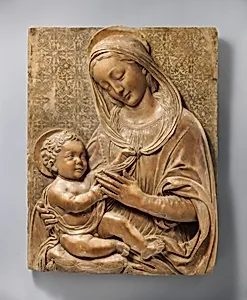
Madonna and Child
ca. 1490
Medium
Marble, painted background
Dimensions
Overall (confirmed): 28 × 21 1/2 × 6 in., 140 lb. (71.1 × 54.6 × 15.2 cm, 63.5 kg)
Classification
Sculpture
Culture
Italian, Florence
Department
European Sculpture and Decorative Arts
Museum
Metropolitan Museum of Art, New York, NY
Credit
Bequest of George Blumenthal, 1941
Accession Number
41.190.137
Rights
Public Domain
Tags
Art Historical Context
Behold the tender "Madonna and Child," marble relief sculpted by Benedetto da Maiano around 1490 in Renaissance Florence. This exquisite work, measuring 28 × 21½ × 6 inches and weighing 140 pounds, the Virgin Mary cradling the infant Christ in a classic devotional pose. The painted background adds a vivid, colorful dimension to the cool white marble, enhancing the sculpture's lifelike presence and inviting viewers into a moment of quiet intimacy. Crafted during Florence's quattrocento golden age, when artists like da Maiano advanced the city's sculptural legacy, this piece reflects the era's deep religious fervor and humanistic ideals. Marble reliefs like this were prized for home altars or private chapels, blending technical precision with emotional depth. Da Maiano, a master of Florentine workshops, contributed to the evolution from Gothic to Renaissance forms, emphasizing graceful figures and subtle modeling. Today, this treasured sculpture graces the Metropolitan Museum of Art's European Sculpture and Decorative Arts department, thanks to the 1941 bequest of George Blumenthal. It stands as a poignant reminder of Italy's artistic heritage, where stone was transformed into eternal symbols of maternal love and divine grace.
About the Artist
Benedetto da Maiano · 1442–1497
**Benedetto da Maiano** (1442–1497) was a leading Italian sculptor and architect of the Early Renaissance, renowned for his mastery of marble and his ability to blend narrative detail with elegant decoration. Born in the village of Maiano near Fiesole, he began his career collaborating with his elder brother, the architect and intarsia specialist Giuliano da Maiano. At around age thirty he trained...