
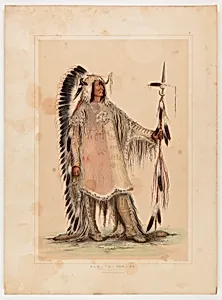
Mah-to-toh-pa, the Mandan Chief
Medium
Graphic Arts-Print
Classification
Graphic Arts-Print
Department
Smithsonian Collection
Museum
Smithsonian American Art Museum
Credit
Smithsonian American Art Museum, Transfer from the National Museum of Natural History, Department of Ethnology, Smithsonian Institution
Accession Number
1985.66.386,593J
Rights
Public Domain
Tags
Art Historical Context
George Catlin's *Mah-to-toh-pa, the Mandan Chief* the dignified presence of a prominent leader from the Mandan tribe, one of the Native American peoples of the Northern Plains. As a pioneering 19th-century artist and ethnographer, Catlin traveled extensively among Indigenous communities in the 1830s, creating portraits that celebrated their cultures amid rapid change from European-American expansion. This full-length depiction highlights Mah-to-toh-pa's stature and regalia, emphasizing his role as a chief in a society known for its fortified villages, agriculture, and vibrant ceremonies. Rendered as a graphic arts print—likely a lithograph or engraving derived from Catlin's oil paintings—this work belongs to his vast portfolio documenting over 140 tribes. Prints like this made his observations accessible to a wider audience, preserving visual records before devastating smallpox epidemics and settler encroachment decimated Mandan populations. Housed in the Smithsonian American Art Museum, it exemplifies Catlin's Romantic style, blending portraiture with anthropological insight to humanize and honor his subjects. Today, this piece invites visitors to reflect on the resilience of Mandan heritage and the power of art in cultural preservation, offering a poignant window into a vanishing world.
About the Artist
George Catlin · 1796–1872
George Catlin (1796–1872), born in Wilkes-Barre, Pennsylvania, to Putnam Catlin and Polly Sutton—who had been captured by Native Americans during the 1778 Battle of Wyoming—initially pursued a legal career. Trained at Litchfield Law School, he was admitted to the bar in 1819 but abandoned law after two years to study art in Philadelphia in 1823. Self-taught as a portraitist, Catlin quickly gained ...