
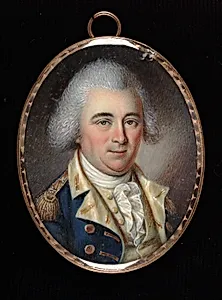
Major-General Anthony Wayne
ca. 1795
Medium
Painting-Miniature
Classification
Painting-Miniature
Department
Smithsonian Collection
Museum
Smithsonian American Art Museum
Credit
Smithsonian American Art Museum, Bequest of Mary Elizabeth Spencer
Accession Number
1999.27.41
Rights
Public Domain
Tags
About this artwork
“Mad Anthony” Wayne (1745-1796) was one of the most colorful figures of the American Revolution. His early training as a surveyor came in handy as he guided his troops during the Valley Forge campaign. Following the surrender of Cornwallis at Yorktown, Washington sent Wayne into South Carolina to chase the British out, after which he was promoted to major general. He returned home in 1783 and reentered the Pennsylvania legislature, where he had served until 1775. When Washington appointed him co...
Art Historical Context
Behold the exquisite miniature portrait of *Major-General Anthony Wayne* James Peale, created around 1795 and now housed in the Smithsonian American Art Museum This intimate bust-length painting captures "Mad Anthony" Wayne (1745–1796) in his major general's uniform, a deliberate choice reflecting his return to the Pennsylvania legislature after a storied military career. Miniatures like this, typically painted on ivory in small scale, were cherished personal keepsakes in the early American republic, blending portraiture with portability for soldiers, statesmen, and families. Wayne earned his bold nickname through daring exploits in the Revolutionary War, from surveying routes at Valley Forge to pursuing British forces in South Carolina after Yorktown, securing his promotion. Later, as commander of the U.S. Army under Washington, he quelled conflicts with Native American tribes along the Great Lakes, culminating in the Treaty of Greenville in 1795—a pivotal step toward frontier peace before his retirement. Peale's precise brushwork highlights the uniform's details, symbolizing Wayne's valor and the young nation's military pride. This artwork offers a window into post-Revolutionary heroism, celebrating a leader who bridged battlefield triumphs with civic duty in an era of nation-building.
About the Artist
James Peale · 1749–1831
James Peale was an American painter born in 1749, the younger brother of the more famous Charles Willson Peale, and a member of one of the most remarkable artistic families in the history of American art. Trained largely by his brother, James worked for many years in Charles Willson's shadow, assisting with portraits and miniatures in the Philadelphia studio before developing his own independent p...