
Man Seated at a Dining Table, Smoking
1899
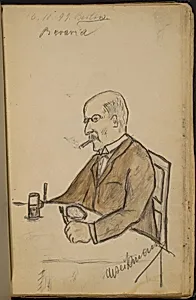
Medium
graphite with pen and black ink and watercolor on wove paper
Classification
Drawing
Department
CG-W
Museum
National Gallery of Art, Washington, D.C.
Credit
Gift of Mrs. Max Beckmann
Accession Number
1984.64.64.2
Rights
Public Domain
Art Historical Context
In the intimate drawing *Man Seated at a Table, Smoking* (1899), Maxmann captures a solitary figure in a moment of quiet contemplation. Created when the artist was just 15 years old this early work on wove paper combines graphite, pen and black ink, and watercolor—a mixed-media technique that showcases Beckmann's precocious command of line, shading, and subtle color. The everyday scene of a man at a dining table evokes the mundane rituals of bourgeois life in fin-de-siècle Germany, rendered with a naturalistic precision that hints at the artist's emerging talent. Beckmann, who would later become a towering figure in German Expressionism and New Objectivity, began his formal training around this time at the Grand Ducal Saxon Academy of Art in Weimar. This drawing reflects his initial explorations in realism, before the distorted forms and psychological intensity of his mature triptychs. The fluid ink lines and delicate watercolor washes demonstrate technical virtuosity on a modest support, underscoring the significance of works on paper in preserving an artist's developmental stages. Generously gifted to the National Gallery of Art by Mrs. Max Beckmann, this piece offers visitors a rare glimpse into the roots of one of modernism's most provocative voices, bridging late 19th-century naturalism with the turbulent Expressionism to come.
About the Artist
Max Beckmann · 1884–1950
Max Carl Friedrich Beckmann (1884-1950) stands as one of the most significant German painters of the twentieth century, a complex artist who bridged Expressionism and the New Objectivity while forging a deeply personal visual language. Born in Leipzig into a middle-class family, Beckmann's artistic journey spanned from academic classicism through the traumatic crucible of World War I to a mature s...