
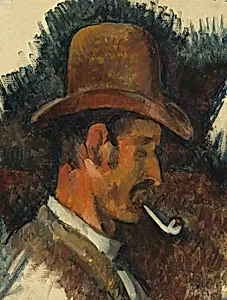
Man with Pipe
1892/1896
Medium
oil on canvas
Dimensions
overall: 26.1 x 20.2 cm (10 1/4 x 7 15/16 in.) framed: 45 x 38.1 x 7.6 cm (17 11/16 x 15 x 3 in.)
Classification
Painting
Department
CF
Museum
National Gallery of Art, Washington, D.C.
Credit
Gift of the W. Averell Harriman Foundation in memory of Marie N. Harriman
Accession Number
1972.9.3
Rights
Public Domain
Art Historical Context
In this small oil painting, a man appears in profile, his head and shoulders filling much of the canvas as he gazes toward the right. He wears a rounded brown bowler hat that sits low on his forehead, and a white clay pipe rests in his mouth. Broad, visible brushstrokes define his ruddy complexion, dark mustache, and the folds of his jacket and white collar. The background is built from energetic strokes of deep brown, blue, and green that press in around the figure, creating a sense of intimate space without clear detail. Paul Cézanne painted Man with Pipe between 1892 and 1896, during the mature phase of his career. Working in oil on canvas, he favored everyday subjects and explored how color and brushwork could convey both volume and atmosphere. Rather than relying on smooth finish or precise outlines, he constructed the man’s features through layered patches of warm and cool tones that give the portrait a quiet, concentrated presence. The work reflects Cézanne’s interest in the dignity of ordinary people and his ongoing effort to balance observed reality with the structure of paint itself. Today in the collection of the National Gallery of Art, it offers visitors a direct encounter with the artist’s distinctive handling of form and color.
About the Artist
Paul Cezanne · 1839–1906
Paul Cézanne (1839–1906), born in Aix-en-Provence to a prosperous banker father, Louis-Auguste, and mother Anne-Elisabeth-Honorine Aubert, grew up in a bourgeois family that later acquired the Jas de Bouffan estate, where he painted his earliest murals. As a youth, he formed the inseparable trio "Les Trois Inséparables" with schoolmates Émile Zola and Baptistin Baille. Despite his father's wishes ...